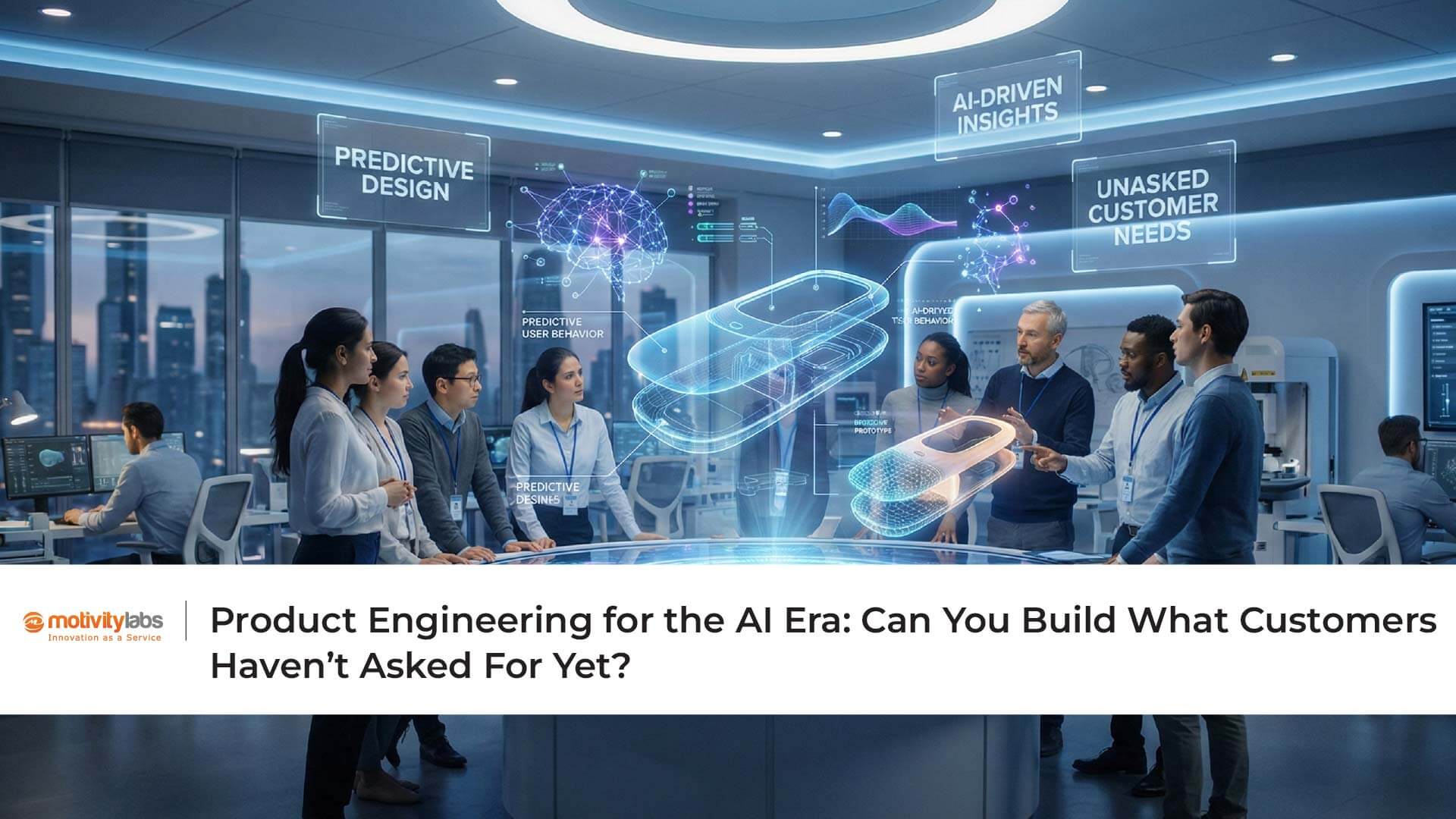
The Question No Roadmap Can Fully Answer
What if your next breakthrough feature never appeared in a customer interview?
What if the most valuable capability your product could offer is something users don’t yet know how to articulate?
This is the paradox defining the AI era. As artificial intelligence becomes embedded in everyday workflows, product teams are no longer just responding to demand – they are anticipating intent. The challenge is no longer “What do customers want?” but “What will customers expect once intelligence becomes invisible?”
In this new landscape, Product Engineering is being pushed beyond execution into foresight – blending systems thinking, data intelligence, and behavioral insight to create products that feel obvious only after they exist.
When Customer Feedback Isn’t Enough Anymore
For decades, customer-centricity has been the gold standard of product development. Interviews, surveys, usability testing, and analytics have shaped roadmaps with precision. But AI changes the equation.
Customers are excellent at describing friction in what they already do. They are far less effective at imagining workflows transformed by autonomous systems, predictive intelligence, or adaptive interfaces.
Consider this reality: in 2024, roughly two-thirds of organizations reported that generative AI was already being used regularly across their operations, according to a global executive survey. When adoption moves this fast, customer expectations evolve before language catches up.
By the time users can clearly ask for AI-driven features, competitors may already be shipping them.
So the real question becomes: how do you engineer products for needs that are still forming?
From Feature Delivery to Capability Discovery
AI-native products aren’t built by simply adding intelligence on top of existing workflows. They require a fundamental shift in how teams think about value creation.
Instead of asking:
What feature should we build next?
The better questions are:
What decisions can we remove friction from?
What outcomes can the system anticipate?
What signals can the product learn from without explicit instruction?
This is where Product Engineering moves from feature delivery into capability discovery – designing systems that continuously learn, adapt, and improve without waiting for manual intervention.
The goal isn’t to surprise users with complexity. It’s to deliver experiences that feel intuitive, timely, and almost predictive.
The Rise of AI Agents and Invisible Workflows
One of the most telling signals of where enterprise software is headed comes from forward-looking platform forecasts. By 2026, analysts expect around 40% of core enterprise applications to embed task-specific AI agents, a dramatic jump from low single-digit penetration just a few years ago.
This shift signals something important: intelligence is no longer a feature — it’s becoming infrastructure.
AI agents don’t wait for clicks. They:
- Monitor patterns continuously
- Trigger actions contextually
- Coordinate across systems autonomously
For product teams, this introduces a new responsibility. You’re no longer designing only for user interaction; you’re designing for machine participation.
That means engineering systems that can:
- Make bounded decisions safely
- Explain outcomes transparently
- Adapt without eroding trust
These are not customer-requested features. They are future expectations being formed right now.
Engineering for Ambiguity, Not Certainty
Traditional development thrives on clarity: defined requirements, scoped use cases, predictable outputs. AI thrives on ambiguity — incomplete data, probabilistic outcomes, evolving behavior.
This tension forces a rethink of how engineering teams operate.
Instead of rigid specifications, teams must design:
Modular architectures that can evolve
Feedback loops that refine intelligence
Guardrails that manage uncertainty responsibly
Here, Product Engineering becomes as much about constraints as creativity. It’s about enabling experimentation while protecting reliability, fairness, and compliance.
The most successful AI-era products are not those that promise perfection, but those that improve visibly over time.
Why “Building Ahead” Requires Trust, Not Just Technology
When you ship capabilities users didn’t explicitly request, trust becomes the currency that determines adoption.
AI-driven features that feel intrusive, opaque, or misaligned with user intent can quickly erode confidence. That’s why engineering decisions must be paired with ethical design principles.
Key considerations include:
- Clear user control over AI-driven actions
- Transparent explanations of system behavior
- Explicit boundaries around automation
Customers may not ask for these safeguards — but they will notice when they’re missing.
Building ahead of demand doesn’t mean building without accountability.
Data as Design Material, Not Exhaust
What if your next breakthrough feature never appeared in a customer interview?
What if the most valuable capability your product could offer is something users don’t yet know how to articulate?
This is the paradox defining the AI era. As artificial intelligence becomes embedded in everyday workflows, product teams are no longer just responding to demand – they are anticipating intent. The challenge is no longer “What do customers want?” but “What will customers expect once intelligence becomes invisible?”
In this new landscape, Product Engineering is being pushed beyond execution into foresight – blending systems thinking, data intelligence, and behavioral insight to create products that feel obvious only after they exist.
The New Skillset Product Teams Must Build
To engineer for unspoken needs, teams themselves must evolve.
The AI era demands hybrid thinkers who understand:
Systems architecture and human behavior
Model limitations and business outcomes
Automation potential and ethical risk
This doesn’t mean every engineer becomes a data scientist. It means collaboration between disciplines becomes non-negotiable.
Product success now sits at the intersection of engineering, design, data, and strategy — not in any one function alone.
So, Can You Build What Customers Haven’t Asked For Yet?
The honest answer? Only if you stop waiting for permission.
The AI era rewards teams that:
Observe patterns before they become requests
Design for outcomes, not instructions
Engineer systems that evolve with their users
Customers may not ask for intelligence.
They may not request automation.
They may not articulate anticipation.
But once they experience it, they won’t accept anything less.
And that is the true challenge and opportunity facing modern product teams today.