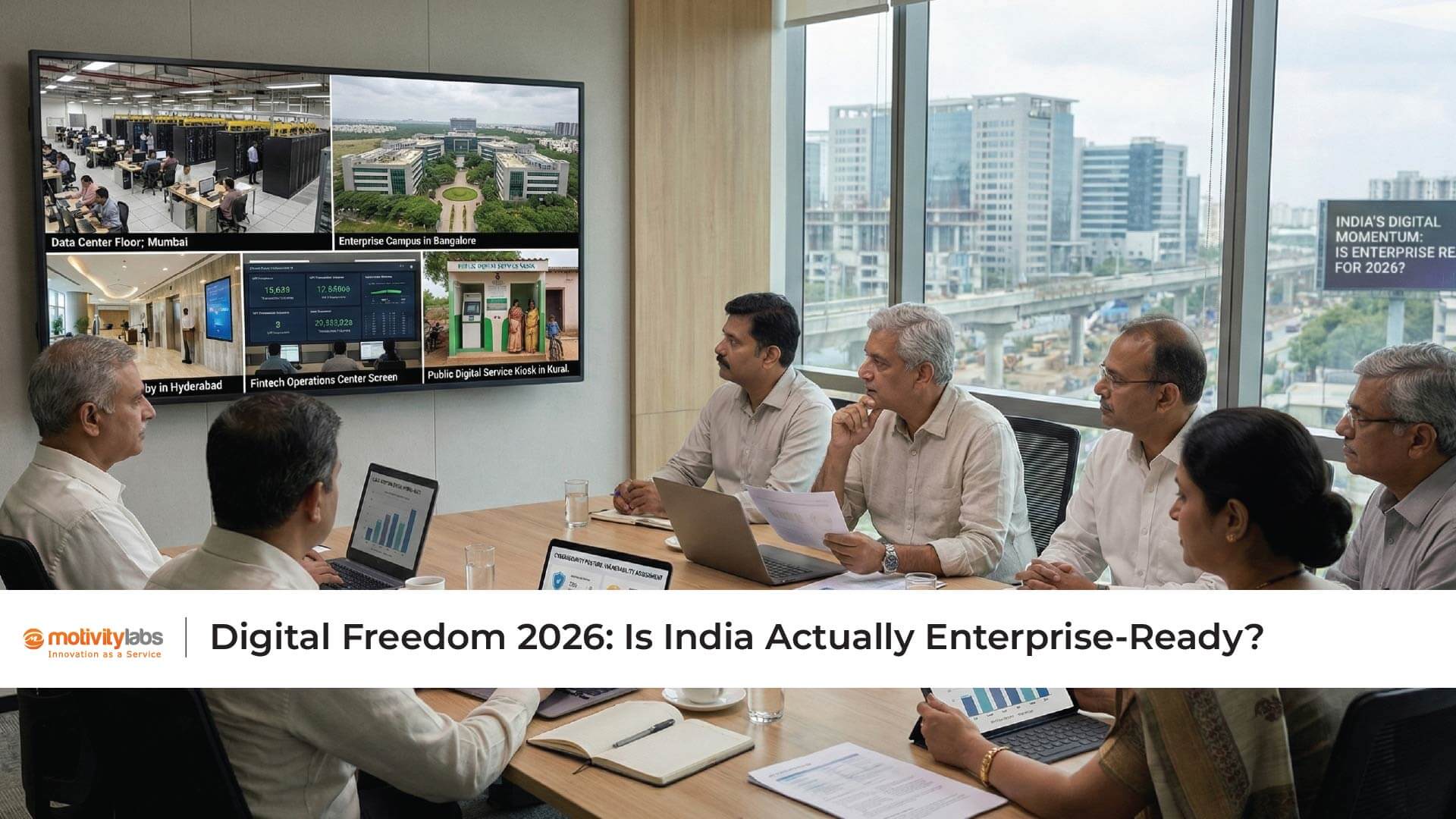
Are we mistaking momentum for maturity? Is scale the same as readiness? And when we say India is digitally free by 2026, what does that really mean for enterprises operating at the edge of complexity?
In 2025 alone, India added 387 MW of new data-centre capacity-more than double the previous year, a 103% year-on-year jump. Infrastructure, clearly, is accelerating. But infrastructure is only one piece of the puzzle. The deeper question remains: is the ecosystem ready for large-scale enterprise digitization, or are we building highways faster than we are training drivers?
This is where the conversation around Enterprise digital readiness in India truly begins.
The Promise of Digital Freedom in 2026
Digital Freedom 2026 is not just a slogan. It represents a moment when India aims to be frictionless for enterprises-digitally connected, cloud-native, data-driven, and resilient by design.
From public platforms to private enterprise systems, India digital transformation 2026 is being shaped by three powerful forces:
- Rapid cloud adoption
- Massive data-center expansion
- Policy-driven digital public infrastructure
The ambition is bold: make India one of the most enterprise-friendly digital economies in the world.
But readiness is not measured by ambition alone. It is measured by how well enterprises can adopt, integrate, secure, and scale technology across operations.
Infrastructure Is Growing Fast - But Is It Enough?
There is no denying the scale of India data center capacity growth. Adding 387 MW of IT load in a single year signals a market preparing for hyperscale workloads, AI platforms, and national-scale applications.
This growth directly strengthens India cloud infrastructure readiness. With hyperscalers expanding across Mumbai, Chennai, Hyderabad, and Noida, latency is falling, redundancy is improving, and enterprises finally have domestic-grade cloud choices.
At the same time, the Indian public cloud market is projected to reach $25.5 billion by 2028, growing at a CAGR of roughly 24% from 2023. This is not experimentation anymore—it is mainstream enterprise migration.
And yet, infrastructure maturity does not automatically translate into operational maturity.
True readiness depends on:
- Application modernization
- Data architecture maturity
- Integration across legacy and cloud systems
- Workforce capability
This is where many organizations still struggle.
Enterprise Technology Adoption: Momentum Meets Reality
Enterprise technology adoption in India has reached a tipping point. ERP modernization, cloud-native development, AI pilots, and data platforms are now boardroom priorities.
However, adoption patterns reveal a gap:
- Many enterprises run hybrid environments with fragmented architectures
- Legacy systems remain deeply embedded in core operations
- Cloud migration is often lift-and-shift, not true modernization
This is the heart of Enterprise IT modernization India.
Modernization is not about moving workloads-it is about rethinking processes, redesigning architectures, and enabling continuous change.
Without this, digital freedom becomes surface-level: connected, but not agile.
The Cyber Reality: Readiness Is Also About Resilience
If infrastructure shows ambition, cybersecurity reveals vulnerability.
In 2025, CERT-In handled over 29.44 lakh cyber incidents. That number alone reframes the conversation. Digital scale is increasing faster than security maturity.
This raises urgent questions about the cybersecurity readiness of Indian enterprises:
Are security operations real-time or still reactive?
Are identities, APIs, and data pipelines secured by design?
Are boards treating cyber risk as a business risk, not just an IT risk?
As the Digital economy of India 2026 expands, every new API, platform, and cloud workload increases the attack surface.
Readiness, therefore, is not just about speed-it is about survivability.
Is India Ready for Large-Scale Enterprise Digitization?
So, is India ready for large scale enterprise digitization?
The honest answer is: structurally yes, operationally uneven.
India now has:
- World-class digital public infrastructure
- Hyperscale cloud availability
- A fast-growing enterprise SaaS ecosystem
But readiness varies sharply by sector and maturity level.
The biggest challenges in enterprise digital transformation India today include:
- Fragmented legacy estates
- Shortage of deep cloud and security talent
- Siloed data platforms
- Weak observability across complex systems
This is why Digital infrastructure for enterprises in India must be paired with architectural discipline, governance, and continuous modernization.
This is also where Enterprise digital readiness in India becomes a strategic capability-not a checkbox.
From Platforms to Performance: Where Enterprises Often Get Stuck
Many organizations have cloud accounts, analytics tools, and automation platforms. Fewer have:
- End-to-end visibility across systems
- Unified data foundations
- Predictive operations
- Security embedded into DevOps
Digital freedom is not achieved when systems are deployed.
It is achieved when systems perform reliably, scale predictably, and recover intelligently.
This is the difference between adoption and readiness.
And this gap is where solution partners play a defining role.
How Motivity Labs Helps Enterprises Build True Readiness
In this landscape, Motivity Labs focuses not on isolated tools, but on enterprise-wide digital operating models.
Their approach addresses the core blockers to Enterprise digital readiness in India:
1. Cloud-Native Modernization: Motivity helps enterprises move beyond lift-and-shift to true cloud-native architectures-microservices, API platforms, and resilient data layers. This directly strengthens India cloud infrastructure readiness at the application level.
2. Intelligent Observability & Security: By integrating AI-driven monitoring, predictive analytics, and security-by-design frameworks, they improve the cybersecurity readiness of Indian enterprises while reducing operational blind spots.
3. Data-Driven Transformation: Motivity enables enterprises to build unified data platforms that support AI, real-time decisioning, and regulatory compliance-critical for the Digital economy of India 2026.
4. Continuous Modernization : Instead of one-time projects, their models emphasize continuous Enterprise IT modernization India-ensuring systems evolve as fast as markets do. This is where digital innovation becomes practical, not aspirational.
The Bigger Picture: Freedom Is an Ongoing Process
Digital Freedom 2026 will not arrive as a single milestone.
It will emerge gradually, unevenly, and sector by sector.
Some enterprises will operate as:
- Fully cloud-native
- AI-augmented
- Secure by design
- Data-first organizations
Others will still be modernizing core systems and governance.
The real test is not whether India can build digital infrastructure.
It is whether enterprises can govern complexity, secure scale, and sustain transformation over time.
And that brings us back to the central question.
Future Outlook: Readiness Is a Moving Target
By 2026, India will almost certainly be one of the world’s most digitally connected economies.
But Enterprise digital readiness in India will remain a moving target.
Because:
- Technology will evolve
- Threats will intensify
- Business models will shift
- Regulations will tighten
Readiness, then, is not a destination.
It is a discipline.
Enterprises that treat digital transformation as a continuous capability-rather than a one-time program-will define the next phase of India’s digital leadership.
The real freedom will belong not to those who adopt technology fastest, but to those who master it most responsibly.