What if most of your data budget isn’t actually fueling innovation, AI, or growth but quietly keeping the lights on?
What if your data teams spend more time maintaining yesterday’s systems than building tomorrow’s capabilities?
In many organizations, this isn’t a hypothetical question. It’s a hard reality.
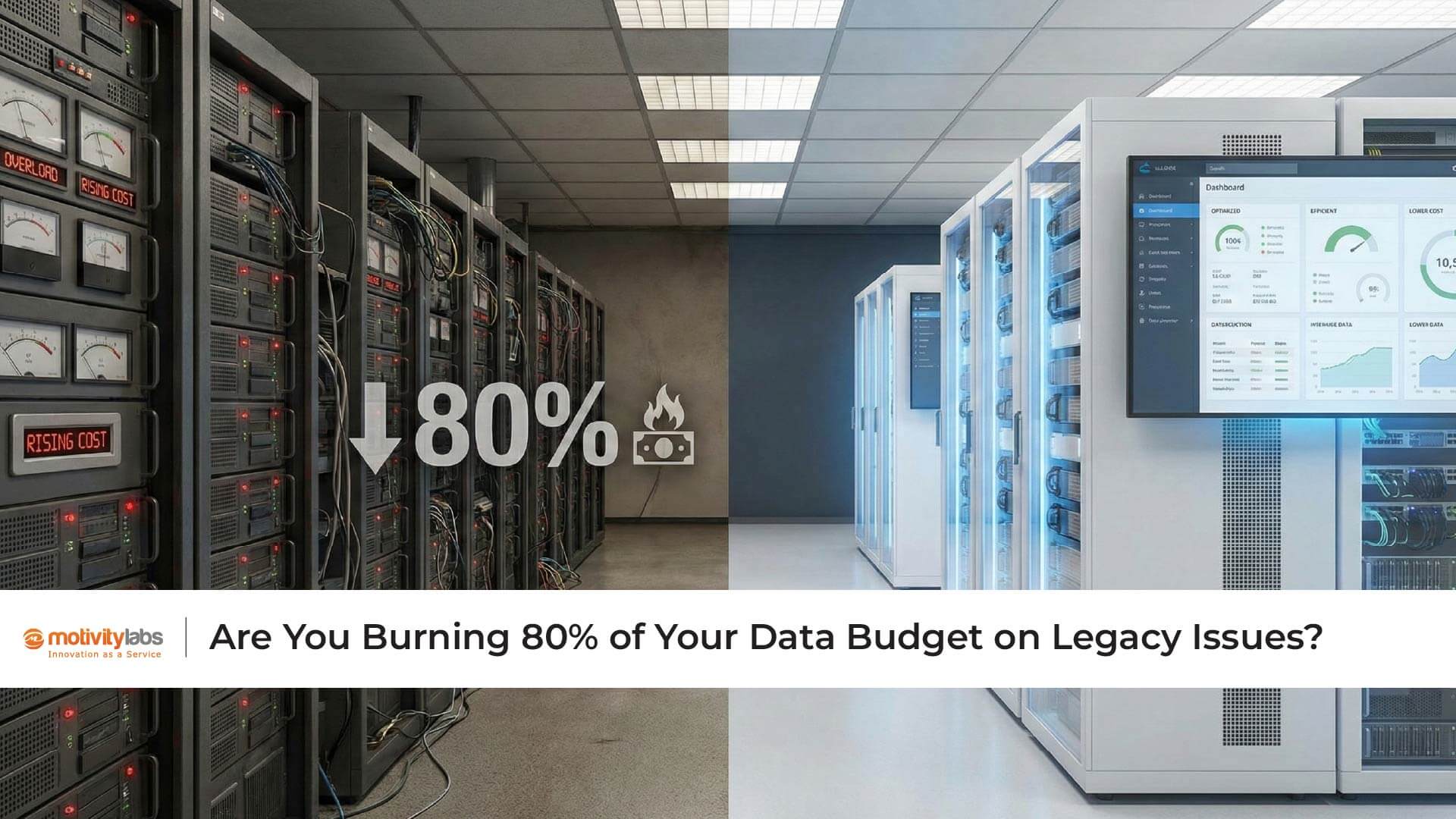
Studies show that 60–80% of IT budgets are consumed by maintaining outdated legacy systems in many enterprises. That’s not a modernization problem. That’s a strategic choke point-one that directly impacts speed, scalability, and competitiveness.
Welcome to the hidden cost of legacy data systems.
The Quiet Budget Drain No One Talks About
On paper, most enterprises claim to be ‘data-driven.’ In practice, a significant portion of their spend is locked into infrastructure decisions made decades ago.
Legacy data systems weren’t designed for:
- Real-time analytics
- AI and machine learning workloads
- Cloud-native scalability
- Rapid experimentation and iteration
Yet, they continue to sit at the core of modern enterprises.
The U.S. Government Accountability Office offers a striking benchmark: 80% of federal IT budgets go toward maintaining legacy systems, leaving only a fraction available for modernization or innovation. While this statistic comes from the public sector, the pattern mirrors what many large enterprises face globally.
The result? Escalating data engineering costs, slower decision cycles, and an ever-growing pile of technical debt in data platforms.
When Maintenance Becomes the Default Strategy
Legacy environments create a paradox. They are considered “too critical to change,” yet increasingly incapable of supporting what the business needs next.
Consider this:
On average, a single legacy system can cost approximately 30 million USD per year in maintenance. These costs aren’t just infrastructure or licensing fees. They include:
- Specialized talent to keep aging systems operational
- Custom integrations and workarounds
- Higher incident response and downtime risks
- Security patches for architectures never designed for today’s threat landscape
Over time, maintenance quietly replaces innovation as the default strategy. Teams aren’t choosing stagnation—it’s forced upon them by the architecture they inherit.
This is why reducing data infrastructure costs isn’t just a finance initiative. It’s a leadership imperative.
Why Legacy Still Dominates the Enterprise Stack
If legacy systems are so expensive and limiting, why do organizations still rely on them?
A 2025 survey found that 62% of organizations still rely heavily on legacy software systems. Even more telling, approximately 70% of the software powering Fortune 500 companies was developed 20 or more years ago.
This persistence isn’t about resistance to change alone. It’s driven by:
- Deep coupling between systems and business processes
- Fear of operational disruption
- Poor visibility into modernization pathways
- Siloed ownership across data, applications, and infrastructure
What starts as risk avoidance eventually becomes risk accumulation—manifesting as brittle pipelines, delayed insights, and ballooning technical debt in data platforms.
The Hidden Costs of Legacy Data Platforms
The true cost of legacy data systems rarely shows up as a single line item. Instead, it surfaces across the organization in subtle but damaging ways.
1. Slower Time to Insight: Legacy architectures struggle with real-time or near-real-time processing. Decision-makers operate on stale data, limiting responsiveness in fast-moving markets.
2. Talent Drain: Modern data engineers want to work with cloud platforms, scalable pipelines, and advanced analytics—not outdated tooling. Legacy environments make hiring and retention harder, driving up data engineering costs.
3. Innovation Bottlenecks:When every change requires weeks of regression testing or manual intervention, experimentation dies. This explains why data teams spend more on maintenance than innovation in legacy-heavy organizations.
4. Compounding Technical Debt:Each workaround adds complexity. Each integration becomes harder to untangle. Over time, even small changes become high-risk initiatives.
These are the hidden costs of legacy data platforms—costs that quietly erode competitiveness.
Data Modernization: More Than a Technology Upgrade
Data modernization is often misunderstood as a simple migration to the cloud or a tool replacement exercise. In reality, it’s a foundational shift in how organizations think about data value.
True data modernization addresses:
- Architecture (from monoliths to modular, scalable systems)
- Pipelines (from batch-heavy to event-driven and real-time)
- Governance (embedded, not bolted on)
- Consumption (analytics, AI, and business intelligence designed for self-service)
This is where the comparison between a modern data stack vs legacy systems becomes unavoidable. Modern stacks are built for adaptability. Legacy stacks are built for stability at all costs—even when that cost becomes unsustainable.
Legacy System Modernization Without Breaking the Business
One of the biggest myths around legacy system modernization is that it requires a risky “rip and replace” approach. In reality, successful enterprise data transformation is incremental, strategic, and business-aligned.
Effective modernization strategies often include:
- Co-existing legacy and modern platforms during transition
- Prioritizing high-impact use cases first
- Decoupling data from applications
Gradually retiring the most expensive components
A well-defined cloud data modernization strategy allows organizations to unlock value early while managing risk—rather than postponing modernization indefinitely.
How Motivity Labs Makes Data Modernization Practical
At Motivity Labs, data modernization is not treated as a theoretical roadmap—it’s an execution discipline.
Motivity Labs helps enterprises:
- Identify where legacy data systems are driving the highest cost and risk
- Quantify hidden data engineering costs and technical debt
- Design modernization paths aligned to business outcomes, not just architecture diagrams
- Build scalable, cloud-ready data platforms that support analytics, AI, digital innovation and real-time decisioning
Rather than forcing wholesale change, Motivity Labs focuses on enterprise data transformation that delivers measurable impact—faster insights, lower operational overhead, and future-ready data ecosystems.
By combining deep engineering expertise with business context, Motivity Labs enables organizations to modernize without disruption—and innovate without compromise.
From Cost Center to Growth Engine
The goal of data modernization isn’t merely to spend less. It’s to spend better.
When legacy constraints are removed:
- Data becomes a strategic asset, not a maintenance burden
- Teams shift from firefighting to forward-thinking
- Innovation cycles accelerate
- Organizations regain the ability to compete on insight, not just scale
This is how enterprises move from managing legacy data systems to building platforms that actively drive growth.
Outlook: The Future Belongs to the Modernized
The question is no longer whether organizations will modernize their data platforms-it’s when.
As AI adoption accelerates, regulatory expectations tighten, and markets move faster, legacy systems will become increasingly unsustainable. Enterprises that delay will find themselves spending more to achieve less.
Those that invest in data modernization today will be better positioned to:
- Reduce long-term infrastructure and maintenance costs
- Enable real-time, intelligent decision-making
- Attract top data talent
- Transform data from an operational expense into a competitive advantage
The future belongs to organizations that stop burning 80% of their data budget on the past—and start investing in what comes next.