If everything is a priority, what actually deserves investment first?
That’s the quiet question many CIOs are wrestling with as 2026 approaches. Budgets may be growing, technologies are maturing faster than ever, and yet the margin for error feels smaller. Every decision now carries long-term implications not just for IT teams, but for enterprise resilience, growth, and relevance.
The CIO Tech Investment Strategy 2026 can no longer be about chasing trends or spreading bets evenly. It has to be intentional, value-led, and deeply aligned with business outcomes. The challenge isn’t a lack of options-it’s deciding what to fund, what to scale, and what to stop.
Why 2026 Is a Defining Year for CIOs
Is 2026 just another checkpoint in digital transformation or a real inflection point?
Across industries, technology has moved from being an enabler to becoming the operating backbone of the enterprise. AI is embedded into workflows, cloud is no longer optional, and cybersecurity has board-level visibility. At the same time, CIOs are under pressure to prove ROI, manage risk, and support growth with finite resources.
This makes IT investment planning 2026 fundamentally different from previous cycles. The focus is shifting from experimentation to execution, from capability-building to measurable impact.
Reframing CIO Technology Priorities for 2026
Before allocating budgets, CIOs must rethink how priorities are framed.
Instead of asking “What technologies should we invest in?” the better question is:
“Which technology investments directly strengthen our ability to compete?”
This mindset shift is central to CIO technology priorities 2026, where decisions are guided by outcomes such as operational resilience, faster decision-making, improved customer experience, and regulatory readiness.
A useful starting lens:
- Does this investment scale across the enterprise?
- Does it reduce long-term complexity?
- Can its value be measured within 12–24 months?
If the answer is unclear, the priority probably is too.
AI: From Curiosity to Core Strategy
Is AI still experimental—or has it become unavoidable?
According to a McKinsey report published in January 2025, over the next three years, 92% of companies plan to increase their AI investments. That single statistic signals a clear shift: AI is no longer a “future bet,” it’s a competitive necessity.
For CIOs, this changes the AI investment strategy for CIOs entirely. The focus in 2026 should not be on pilots, but on:
- Embedding AI into core business processes
- Standardizing platforms instead of isolated tools
- Building governance models that manage risk, bias, and compliance
AI investments should be prioritized where they augment decision-making, automate high-friction workflows, and unlock productivity at scale. The CIO’s role is to ensure AI spend translates into enterprise-wide capability—not fragmented innovation.
Enterprise Software: Investing Where Platforms Matter
With AI scaling, what happens to the rest of the software stack?
Enterprise software is entering a new growth phase. Enterprise software spend is forecast to grow by approximately 15.2% in 2026, reaching about USD 1.43 trillion, reflecting the demand for integrated, scalable platforms.
For CIOs, this trend directly affects enterprise technology investments. The key priority is not adding more tools, but rationalizing and modernizing existing systems:
- Reducing overlapping applications
- Consolidating onto fewer, more capable platforms
- Ensuring software investments support AI, data, and automation goals
Software decisions made in 2026 will shape technical debt for the next decade. This makes platform thinking—not feature chasing—central to any credible CIO digital strategy 2026.
Cybersecurity: No Longer a Defensive Line Item
Is cybersecurity still treated as insurance or as infrastructure?
As digital dependency increases, cyber risk becomes a business continuity issue. This is why cybersecurity investment priorities are climbing steadily on CIO agendas, especially in regulated and public-sector environments.
Notably, 52% of government CIOs outside the U.S. expect their IT budgets to increase in 2026, with cybersecurity, AI, and cloud among the top focus areas. This signals a broader global trend: resilience is becoming non-negotiable.
For CIOs, prioritization should shift toward:
- Zero-trust architectures
- Identity-first security models
- Security tooling that integrates with cloud and AI systems
Cybersecurity investments that reduce operational risk and incident response time will increasingly be viewed as growth enablers—not cost centers.
Cloud Modernization: Optimizing, Not Just Migrating
If most enterprises are already in the cloud, what comes next?
The cloud conversation in 2026 is less about migration and more about optimization. A mature cloud modernization strategy 2026 focuses on:
- Cost visibility and workload optimization
- Hybrid and multi-cloud governance
- Cloud-native architectures that support AI and data workloads
CIOs should prioritize investments that simplify cloud operations and improve performance predictability. This also ties directly into sustainability goals, as inefficient cloud usage increasingly attracts scrutiny from both finance and ESG stakeholders.
Building a Technology ROI Framework That Actually Works
How do CIOs justify growing spend while being asked to “do more with less”?
This is where a strong technology ROI framework for CIOs becomes critical. In 2026, ROI measurement can no longer be limited to cost savings alone. CIOs must evaluate returns across:
- Productivity gains
- Risk reduction
- Speed-to-market
- Business agility
Successful CIOs are those who can translate technical outcomes into business language—linking investments directly to revenue protection, growth acceleration, or compliance readiness.
This framework also helps CIOs make harder calls: sunsetting underperforming systems, delaying low-impact initiatives, and reallocating funds toward higher-value opportunities.
Aligning the CIO Roadmap with Business Reality
Is the technology roadmap built for IT—or for the enterprise?
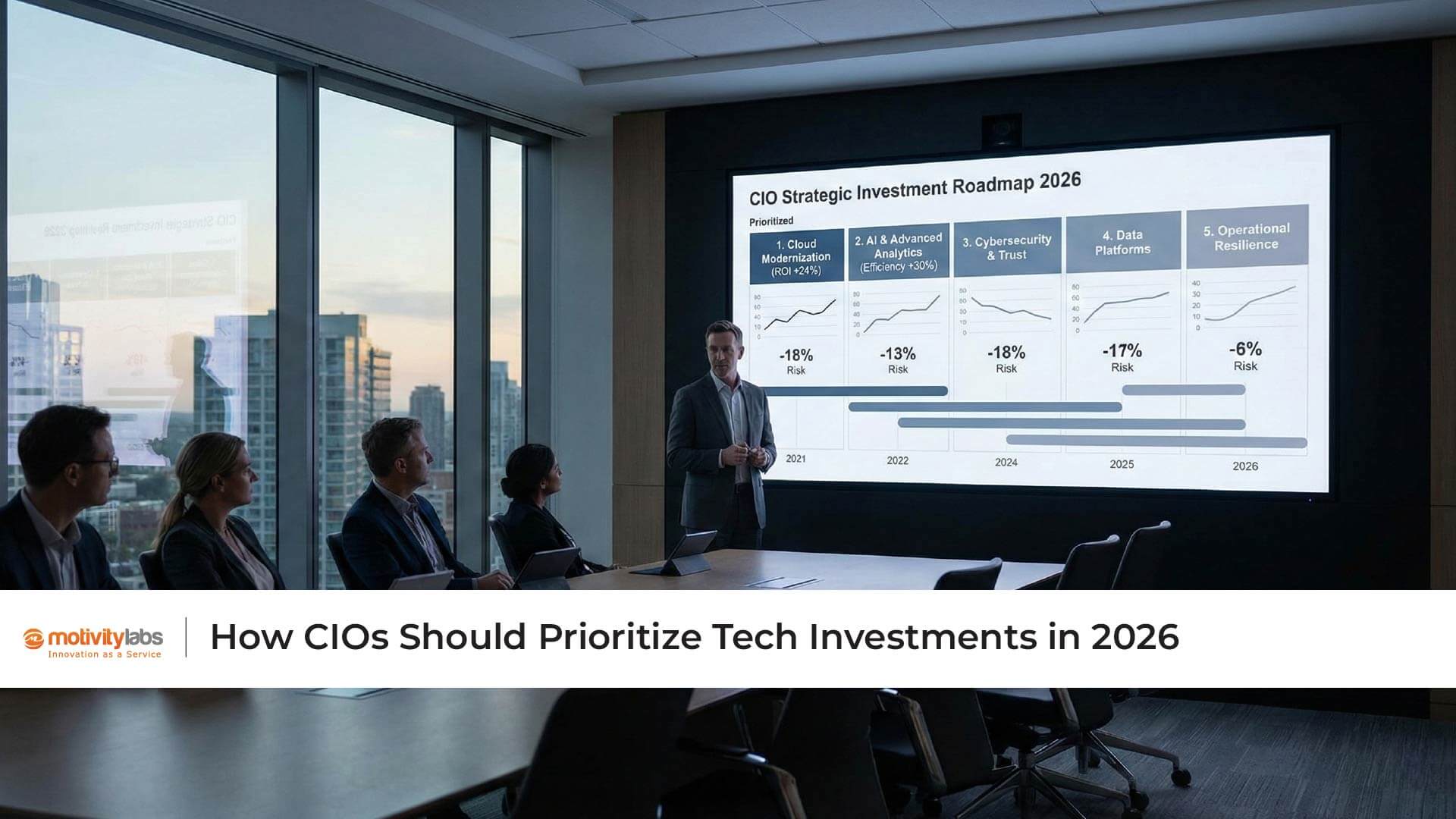
A credible CIO roadmap 2026 must align tightly with business strategy. This means:
- Coordinating closely with CFOs on capital allocation
- Working with CHROs on skills and workforce readiness
- Supporting CEOs with real-time insights and operational visibility
Technology investments should be sequenced to deliver incremental value, not just long-term promise. Roadmaps that balance quick wins with foundational upgrades tend to earn greater executive trust and sustained funding.
The Hidden Priority: Capability and Change
Even the best technology fails without adoption.
While tools and platforms dominate budget discussions, CIOs must also prioritize change management, training, and operating model redesign. As enterprise IT spending trends 2026 show continued growth, the differentiator will not be access to technology—but the ability to use it effectively.
This often means investing in:
- Upskilling teams for AI and cloud-native environments
- Redesigning processes around automation
- Establishing cross-functional ownership for digital initiatives
These investments may not always look “technical,” but they determine whether technical investments succeed.
Future Outlook: From Spend to Strategy
Looking ahead, 2026 will reward CIOs who treat technology investment as strategic capital—not operational expense.
The enterprises that thrive will be led by CIOs who:
- Prioritize platforms over point solutions
- Measure value beyond cost reduction
- Balance innovation with resilience
- Align IT decisions tightly with business outcomes
The CIO Tech Investment Strategy 2026 is ultimately about clarity—knowing where technology truly moves the needle and having the discipline to invest accordingly.
As technology continues to shape how enterprises compete, the CIO’s role will only grow more influential. The question isn’t whether to invest—but how wisely those investments are made.