Introduction: Are Your Legacy Systems Holding You Back?
Is your enterprise running on technology that once powered growth but now silently slows it down? If so, you’re not alone. 62% of organizations still rely on legacy software, even as customer expectations, cybersecurity risks, and scalability demands continue to evolve.
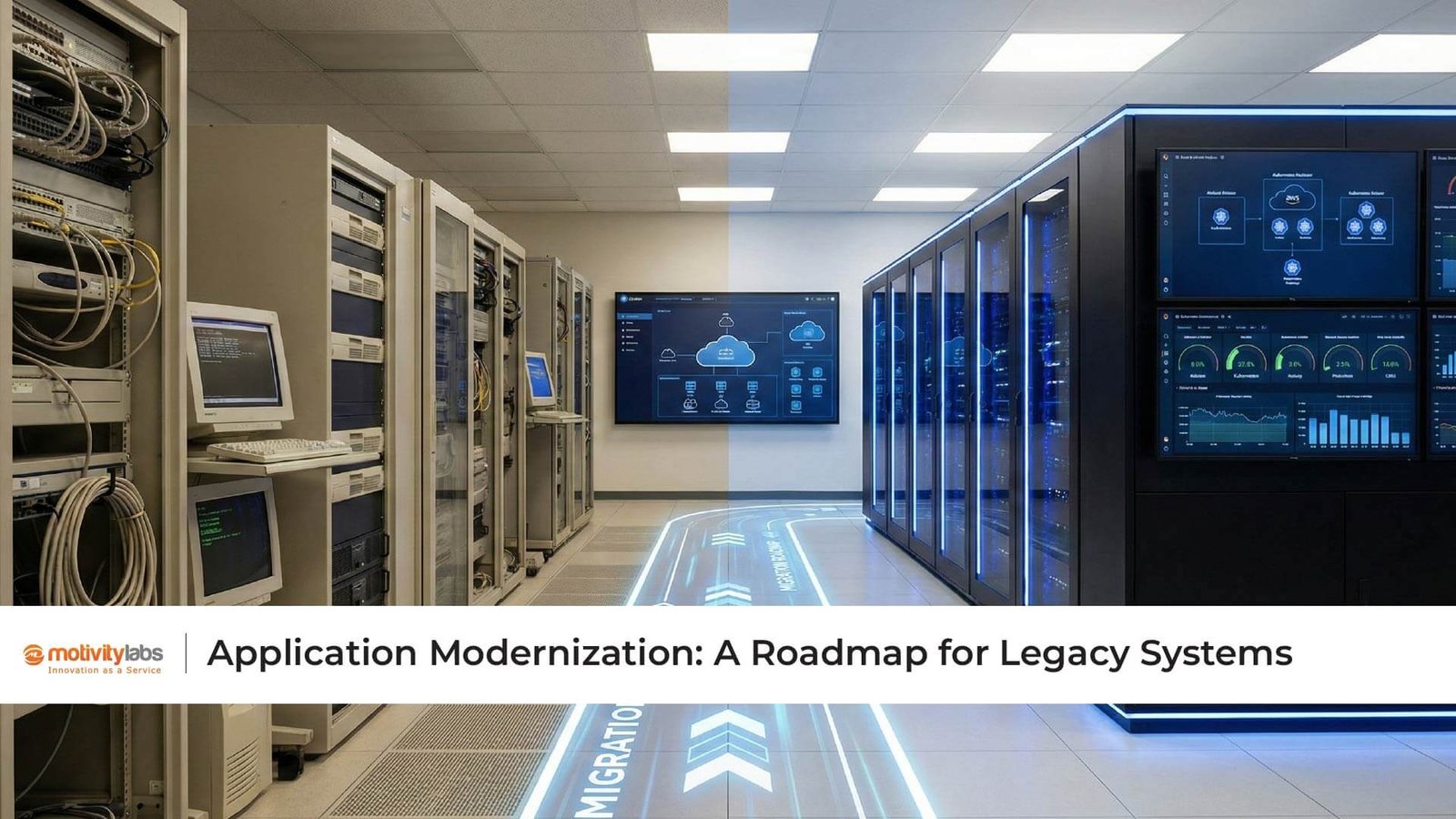
This is where Application Modernization becomes more than a technology upgrade; it becomes a strategic business imperative. Modern enterprises cannot afford brittle architectures, outdated codebases, or siloed systems. The challenge isn’t whether to modernize, but how to approach Legacy System Modernization without disrupting mission-critical operations.
In this blog, we’ll explore a practical roadmap for Legacy Application Modernization, key strategies like replatforming vs rehosting, and how enterprises can unlock agility, resilience, and long-term value.
What is Application Modernization?
Application Modernization refers to transforming legacy applications to align with current business needs, cloud environments, and emerging technologies. It can involve:
- Migrating monolithic systems to cloud-native platforms
- Refactoring legacy applications for scalability
- Implementing microservices architecture transformation
- Integrating DevOps in application modernization
- Enabling automation, analytics, and API-driven ecosystems
At its core, Enterprise Application Modernization ensures that IT systems evolve alongside business strategy.
Why Modernizing Legacy Systems Is Critical Today?
Legacy systems were built for stability, not speed. But today’s enterprises require:
- Real-time data processing
- Seamless cloud integration
- Enhanced cybersecurity frameworks
- Continuous delivery pipelines
- Cost-efficient infrastructure
Modernizing Legacy Systems enables organizations to reduce downtime, enhance performance, and support innovation cycles that were previously impossible with rigid architectures.
Nearly 98% of organizations currently modernizing report measurable improvements in at least one key area, like security, scalability, or reliability. The evidence is clear: modernization delivers tangible results.
Building an Effective Application Modernization Strategy
A successful Application Modernization Strategy must be structured, risk-aware, and outcome-driven. Here’s a step-by-step roadmap:
1. Assess the Current Architecture
Start with a comprehensive audit:
- Code complexity
- Infrastructure dependencies
- Security vulnerabilities
- Licensing costs
- Business criticality
This evaluation helps prioritize workloads for Legacy System Modernization.
2. Define Business Objectives
Modernization should align with measurable goals:
- Improve customer experience
- Enable faster product releases
- Strengthen compliance and governance
- Reduce operational costs
- Support digital innovation
Without business alignment, modernization becomes a technical exercise with limited ROI.
3. Choose the Right Modernization Path
Replatforming vs Rehosting
One of the most critical decisions in Cloud migration for legacy applications is choosing between:
- Rehosting (Lift-and-Shift)
- Move applications to the cloud without major architectural changes
- Faster implementation
- Lower upfront costs
- Limited optimization benefits
Replatforming
- Make targeted optimizations during migration
- Improve performance and scalability
- Moderate complexity
- Better long-term value
Rehosting is suitable for quick migrations. Replatforming provides better operational efficiency and prepares applications for future enhancements.
4. Refactoring Legacy Applications
For deeper transformation, Refactoring legacy applications involves restructuring and optimizing code without altering external functionality.
Benefits include:
- Improved maintainability
- Reduced technical debt
- Enhanced performance
- Better integration capabilities
Refactoring often forms the foundation for microservices and cloud-native adoption.
5. Microservices Architecture Transformation
Monolithic applications limit scalability and agility. A Microservices architecture transformation breaks large systems into independently deployable services.
Advantages:
- Independent scaling
- Faster release cycles
- Fault isolation
- Technology flexibility
This approach is a cornerstone of Enterprise Application Modernization, enabling organizations to innovate faster while maintaining stability.
6. Integrating DevOps in Application Modernization
Adopting DevOps in application modernization ensures continuous integration and continuous deployment (CI/CD).
Key outcomes:
- Faster development cycles
- Automated testing
- Improved collaboration between teams
- Reduced deployment risks
DevOps accelerates modernization by embedding automation and agility into the delivery pipeline.
Technical Debt Reduction Strategies
Legacy systems accumulate technical debt over time due to quick fixes, outdated frameworks, and deferred upgrades.
Effective technical debt reduction strategies include:
- Code refactoring and modularization
- Eliminating redundant integrations
- Upgrading outdated frameworks
- Standardizing APIs
- Implementing automated testing
Reducing technical debt not only improves system health but also enhances developer productivity and security posture.
The Growing Market Momentum
The demand for Application Modernization Services reflects its strategic importance. The market, valued is projected to reach USD 56.6 billion by 2032, growing at a 13.5% CAGR.
This rapid growth underscores how enterprises worldwide are prioritizing Legacy Application Modernization as a competitive differentiator.
Cloud Migration for Legacy Applications
Cloud adoption plays a central role in modernization efforts. Cloud migration for legacy applications enables:
- Elastic scalability
- Reduced infrastructure costs
- Disaster recovery capabilities
- Global deployment flexibility
However, successful cloud migration requires:
- Dependency mapping
- Security configuration alignment
- Data migration planning
- Performance benchmarking
A poorly executed migration can introduce new risks. A structured Application Modernization Strategy ensures smooth transition and sustained performance gains.
Overcoming Common Modernization Challenges
Despite its benefits, modernization is not without hurdles:
- Resistance to Change: Stakeholders often fear disruption. Clear communication and phased rollouts reduce resistance.
- Skill Gaps: Modern architectures require cloud-native expertise and DevOps skills. Upskilling and strategic partnerships help bridge this gap.
- Data Complexity: Legacy systems often store critical data in outdated formats. Data transformation and governance frameworks are essential.
- Business Continuity Risks: Phased migration and parallel environments ensure minimal disruption.
How Motivity Labs Enables Seamless Application Modernization
Modernization requires more than tools,it requires expertise, precision, and execution discipline. This is where Motivity Labs becomes a strategic partner.
Motivity Labs supports Enterprise Application Modernization through:
- Comprehensive Assessment: In-depth application audits to identify modernization priorities and risk areas.
- Customized Application Modernization Strategy: Tailored roadmaps aligned with business outcomes and scalability goals.
- Cloud-Native Transformation: Expertise in Cloud migration for legacy applications, ensuring performance optimization and compliance.
- Microservices & DevOps Integration: Implementing Microservices architecture transformation and embedding DevOps in application modernization pipelines for faster releases.
- Technical Debt Optimization: Structured technical debt reduction strategies that improve system reliability and long-term maintainability.
By combining engineering expertise with business alignment, Motivity Labs ensures that modernization initiatives deliver measurable ROI, not just technical upgrades.
Measuring Success in Legacy System Modernization
To ensure sustainable success, enterprises should track:
- Deployment frequency
- System downtime reduction
- Security incident rates
- Infrastructure cost savings
- Time-to-market improvements
Modernization must translate into operational excellence and competitive advantage.
The Road Ahead
As enterprises move deeper into AI integration, automation, and hyper-connected ecosystems, Application Modernization will remain central to transformation strategies.
Future trends include:
- AI-driven code analysis for automated refactoring
- Serverless architectures replacing traditional workloads
- API-first ecosystems
- Increased adoption of containerization and Kubernetes
- Security-first cloud-native designs
The organizations that proactively invest in Modernizing Legacy Systems today will define tomorrow’s digital leaders.
Application modernization is no longer optional. It is the bridge between legacy stability and future agility.
If survival is the goal for your systems, what’s the goal for your business?