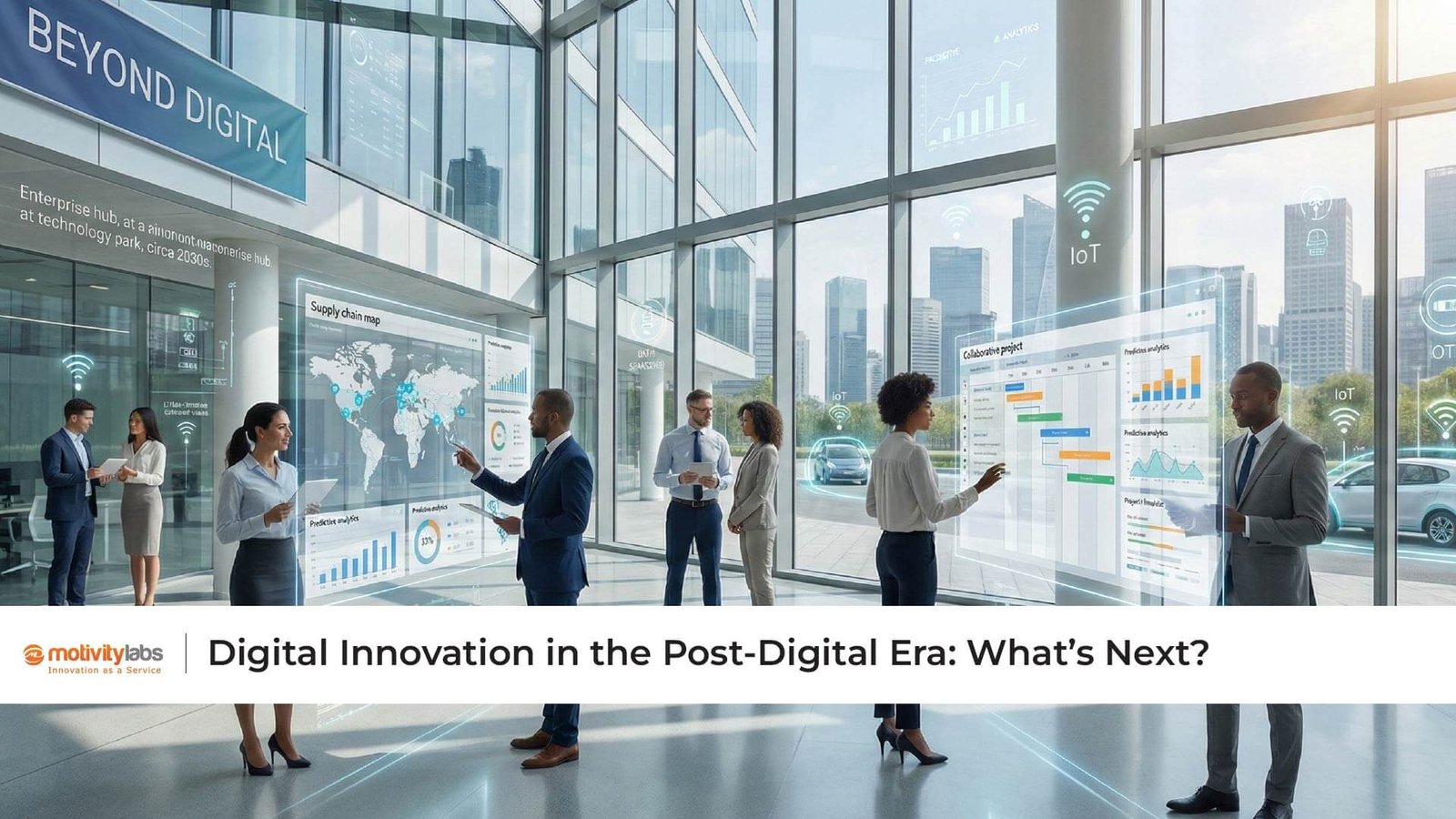
If Digital Was the Destination, Why Does It Feel Like the Beginning?
We’ve spent the last decade talking about digital transformation as the ultimate goal. But what happens after “going digital” becomes the baseline expectation rather than the competitive advantage?
Welcome to the Post-Digital Era, where technology is no longer disruptive by itself, but foundational. In fact, enterprise AI adoption reached 72% globally in 2025, signaling that artificial intelligence is no longer experimental but embedded into mainstream operations. The question now isn’t whether businesses are adopting technology – it’s how intelligently they are evolving beyond it.
This shift defines Digital Innovation in the Post-Digital Era. It’s not about digitizing processes anymore. It’s about reimagining value creation, operational models, and customer experiences in a hyper-connected, AI-powered world.
So what’s next?
What Defines the Post-Digital Era?
The Post-Digital Era is characterized by maturity. Organizations are no longer asking whether they should adopt cloud, AI, or automation – they already have. The challenge now lies in integration, optimization, and differentiation.
In this era:
- Technology is ubiquitous
- Data is abundant
- Customers expect personalization
- Competition is borderless
- Speed defines survival
This requires a refined Digital Innovation Strategy that moves beyond adoption and focuses on impact.
From Enterprise Digital Transformation to Continuous Reinvention
The early phase of Enterprise Digital Transformation focused on migrating workloads, implementing SaaS tools, and digitizing customer journeys. But transformation is not a one-time event.
The digital transformation market itself reflects this momentum. It is valued at USD 2.0 trillion in 2026 and projected to reach USD 5.3 trillion by 2031, growing at a 21.5% CAGR. This explosive growth indicates that transformation is evolving into sustained innovation.
Yet growth alone does not guarantee success.
Only 35% of companies worldwide successfully achieve their digital transformation goals. That means the majority struggle to convert technology investments into measurable business value.
Why?
Because technology without strategy leads to fragmentation. Tools without integration lead to inefficiency. Innovation without governance leads to chaos.
The Rise of AI-Driven Innovation
Artificial intelligence is the defining engine of Next-Generation Digital Innovation. But AI is no longer confined to enterprise labs.
More than one-third of people across OECD countries used generative AI tools in 2025, demonstrating how deeply AI has permeated everyday workflows.
In business environments, AI-driven innovation is powering:
- Intelligent automation
- Predictive analytics
- Real-time personalization
- Fraud detection and cybersecurity
- Autonomous decision systems
The competitive edge in the Post-Digital Era comes not from owning AI tools, but from integrating them seamlessly into operational frameworks.
Emerging Technologies in Business: Beyond AI
AI may dominate headlines, but it is part of a broader ecosystem of Emerging technologies in business shaping the future:
- Hyperautomation combining AI and robotic process automation
- Edge computing for real-time processing
- Blockchain for transparent transactions
- Quantum computing research
- Advanced cybersecurity frameworks
These technologies are reshaping industries, but their effectiveness depends on how well they integrate within an enterprise’s Innovation ecosystem.
Hyperautomation Trends: The New Operational Standard
Automation used to focus on repetitive tasks. Now, Hyperautomation trends combine AI, machine learning, analytics, and robotic process automation into intelligent workflows.
This shift enables:
- End-to-end process automation
- Self-healing systems
- Real-time operational insights
- Reduced human error
- Scalable performance
In the Post-Digital Era, automation is no longer optional. It’s an expectation.
Data-Driven Decision Making as a Strategic Asset
If AI is the engine, data is the fuel.
Organizations that prioritize Data-driven decision making gain:
- Faster strategic pivots
- More accurate forecasting
- Improved customer targeting
- Enhanced risk management
However, many enterprises still operate with siloed data architectures. True innovation requires unified data platforms and governance models that ensure accuracy, accessibility, and compliance.
Digital-First Enterprises: Redefining Competitive Advantage
A defining trait of leaders in the Post-Digital Era is their identity as Digital-first enterprises.
These organizations:
- Embed technology into every business function
- Design customer journeys digitally from inception
- Prioritize agility over hierarchy
- Align IT and business objectives seamlessly
They don’t “do digital.” They are digital.
This mindset shift is central to shaping the Future of Digital Transformation.
The Innovation Ecosystem: Collaboration Over Isolation
Innovation no longer happens in silos. It thrives in ecosystems.
A robust Innovation ecosystem includes:
- Cross-functional collaboration
- Startup partnerships
- Academic alliances
- Open API frameworks
- Developer communities
In the Post-Digital Era, enterprises that collaborate outperform those that isolate.The future of innovation is interconnected.
Why Many Digital Strategies Fall Short
Despite heavy investment, many initiatives underperform because:
- They focus on tools instead of outcomes
- They lack clear governance
- They underestimate cultural change
- They fail to integrate data effectively
- They do not measure impact beyond implementation
True Digital Innovation in the Post-Digital Era requires cultural transformation alongside technological advancement.
How Motivity Labs Enables Next-Generation Digital Innovation
Navigating this complexity requires strategic alignment, technical expertise, and scalable execution. This is where Motivity Labs delivers impact.
Motivity Labs empowers organizations to transition from traditional transformation to Next-Generation Digital Innovation through:
- Strategic Digital Innovation Strategy Design: Aligning business goals with emerging technologies to create outcome-driven roadmaps.
- AI-Driven Innovation Implementation: Embedding intelligent automation and predictive analytics into enterprise workflows.
- Data Modernization & Analytics: Building unified platforms that enable data-driven decision making.
- Hyperautomation Enablement: Designing scalable automation architectures that integrate AI, RPA, and analytics.
- Innovation Ecosystem Integration: Supporting API-driven ecosystems and collaborative innovation models.
By combining engineering precision with strategic foresight, Motivity Labs helps enterprises move beyond experimentation toward sustainable digital innovation.
Measuring Success in the Post-Digital Era
Success metrics are evolving.
Instead of measuring only digital adoption, organizations must track:
- Innovation velocity
- Customer experience improvements
- AI adoption impact
- Automation ROI
- Revenue from digital products
- Operational resilience
Metrics define maturity.
The Cultural Shift: People at the Core
Technology evolves rapidly. Culture evolves slowly.
Enterprises must invest in:
- Continuous learning programs
- Cross-functional collaboration
- Agile methodologies
- Leadership alignment
Without cultural transformation, even the most advanced technologies fail to deliver expected outcomes.
The Future of Digital Transformation: What’s Next?
As we look ahead, the Future of Digital Transformation will likely be defined by:
- Autonomous enterprise systems
- AI-augmented workforces
- Real-time adaptive business models
- Sustainable and ethical AI frameworks
- Seamless human-machine collaboration
The Post-Digital Era is not about more technology. It’s about smarter integration, strategic governance, and measurable outcomes.
Road Ahead : Innovation as a Continuous Imperative
So what’s next?
In the Post-Digital Era, innovation is no longer episodic. It is continuous.
Enterprises must:
- Treat transformation as an ongoing capability
- Invest in scalable AI-driven innovation
- Build adaptive innovation ecosystems
- Prioritize measurable impact over adoption metrics
Digital maturity is no longer a milestone – it’s a moving target.
Digital Innovation in the Post-Digital Era is about redefining competitive advantage in a world where digital is the default.
The future belongs not to those who digitized first –
but to those who innovate continuously.