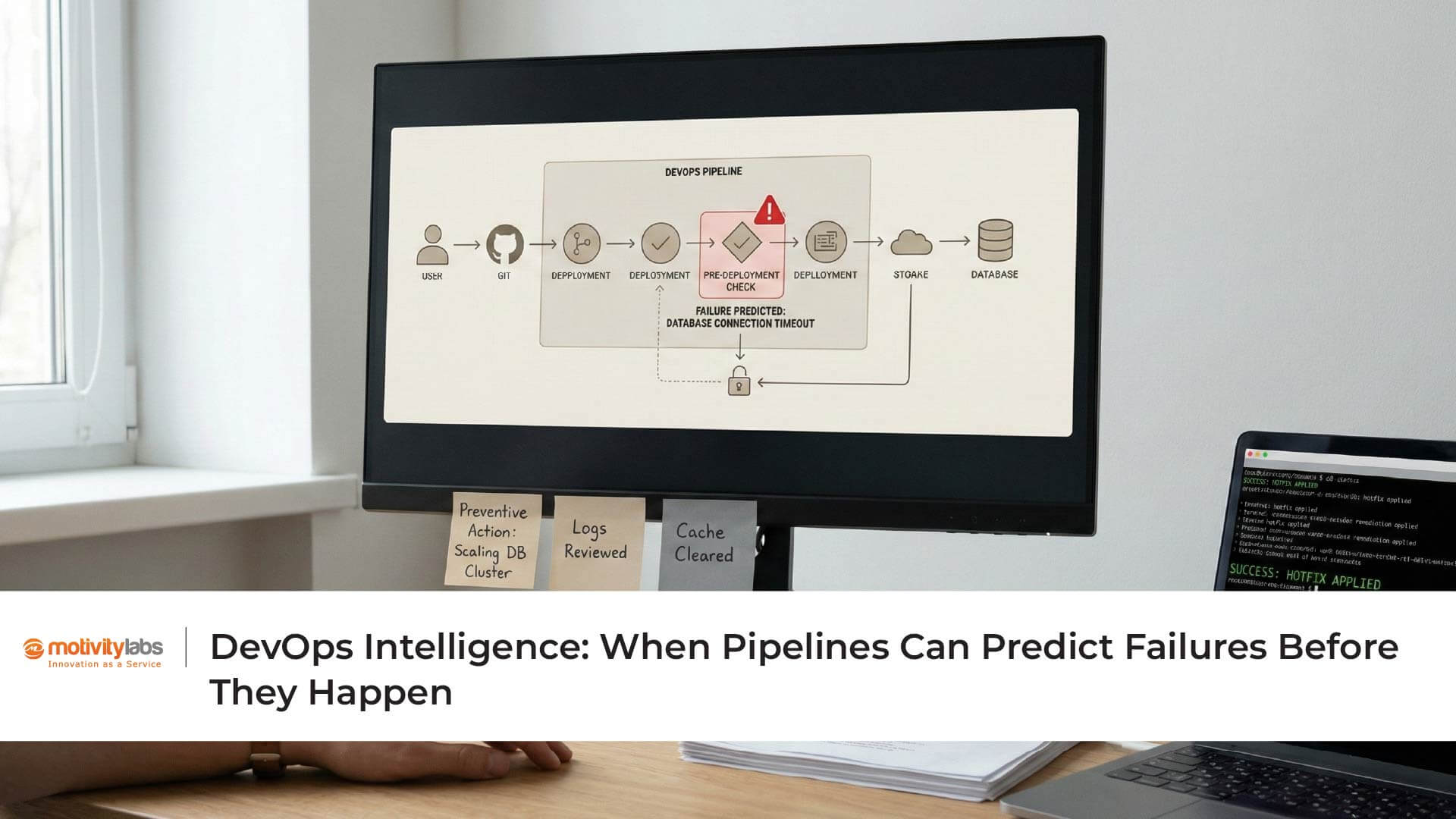
What if your deployment pipeline could sense trouble before it broke production?
What if releases didn’t fail loudly-but quietly corrected themselves before users ever noticed?
For years, software delivery has accepted failure as a given. Build breaks. Tests fail. Rollbacks happen. Teams react. Dashboards light up. War rooms assemble. The process works-but only after something goes wrong.
Today, a more provocative question is emerging: Why wait for failure at all?
As systems grow more complex and release velocity accelerates, traditional automation is no longer enough. The next evolution lies in intelligence-pipelines that observe patterns, learn from history, and predict risk before code reaches production.
Welcome to the era of DevOps Intelligence.
From Automated Pipelines to Intelligent Ones
Early automation transformed software delivery by removing manual steps. CI/CD pipelines standardized builds, testing, and deployments. That alone was revolutionary.
But automation has a ceiling. It executes what it’s told—nothing more.
Modern systems demand something smarter. Pipelines must now:
Detect abnormal test behavior
Correlate code changes with historical incidents
Anticipate infrastructure instability
Understand when “green” doesn’t necessarily mean “safe”
This shift marks the convergence of AIOps and DevOps, where data-driven intelligence augments automation with foresight. Instead of asking “Did something fail?” teams ask “Is something about to fail?”
Why Predictive Failure Matters More Than Speed
Speed has long been the north star of DevOps culture. Faster deployments. Shorter cycles. Continuous delivery.
But speed without predictability introduces risk.
According to industry reports, predictive analytics can improve defect detection rates by up to 45% when applied to testing and automation workflows. That’s not just incremental improvement—it’s a fundamental reduction in uncertainty.
Predictive pipelines analyze signals such as:
- Flaky test behavior
- Commit patterns linked to past incidents
- Resource saturation trends
- Configuration drift over time
The result is earlier intervention—before failures cascade into outages.
From Automated Pipelines to Intelligent Ones
Early automation transformed software delivery by removing manual steps. CI/CD pipelines standardized builds, testing, and deployments. That alone was revolutionary.
But automation has a ceiling. It executes what it’s told—nothing more.
Modern systems demand something smarter. Pipelines must now:
Detect abnormal test behavior
Correlate code changes with historical incidents
Anticipate infrastructure instability
Understand when “green” doesn’t necessarily mean “safe”
This shift marks the convergence of AIOps and DevOps, where data-driven intelligence augments automation with foresight. Instead of asking “Did something fail?” teams ask “Is something about to fail?”
AIOps + DevOps: Where Intelligence Emerges
AIOps brings machine learning, pattern recognition, and anomaly detection into operational data. When combined with DevOps workflows, the result is intelligence embedded directly into the delivery lifecycle.
This convergence enables:
- Predictive deployments, where risk is scored before release
- Zero-touch rollbacks, triggered automatically when anomaly thresholds are crossed
- Smarter gating, where pipelines adapt based on confidence, not static rules
Elite teams already demonstrate the payoff. Studies show they can achieve up to 2604× faster failure recovery compared to traditional approaches, underscoring the real-world impact of optimized practices.
The difference isn’t just tooling—it’s intelligence.
From Automated Pipelines to Intelligent Ones
Traditional pipelines are reactive by design. They respond to failure after it manifests.
Intelligent pipelines operate differently. They prevent failure by:
- Learning which changes historically correlate with instability
- Flagging “risky but passing” builds
- Triggering automated mitigations before customer impact
This transforms release management from firefighting to foresight.
In this model, DevOps becomes less about moving fast and more about moving confidently.
Why Zero-Touch Rollback Changes the Game
Rollbacks used to be a last resort—manual, disruptive, and stressful.
With intelligent pipelines, rollback becomes a strategic control.
Zero-touch rollback systems:
- Continuously monitor post-deployment signals
- Compare live metrics against learned baselines
- Revert automatically when deviations exceed safe thresholds
No human approval required. No waiting for alarms. No customer-visible downtime.
This is not about removing humans—it’s about freeing them from constant vigilance so they can focus on architecture, optimization, and innovation.
The Cultural Shift Behind Intelligent Pipelines
Technology alone doesn’t create DevOps Intelligence. Culture matters just as much.
Teams must shift from:
Blame to learning
Static rules to adaptive models
Gut-feel decisions to data-backed confidence
Intelligent pipelines thrive in environments that value observability, experimentation, and continuous improvement.
Without that mindset, even the best tools underperform.
How Motivity Labs Enables Predictive DevOps Intelligence
Motivity Labs addresses this challenge by engineering intelligence directly into delivery ecosystems—not as an add-on, but as a core capability.
Their approach focuses on:
- Integrating AIOps models into CI/CD pipelines
- Building predictive risk scoring for deployments
- Enabling automated rollback and self-healing workflows
- Designing observability layers that feed continuous learning
Rather than replacing existing tools, Motivity Labs amplifies them—connecting telemetry, logs, metrics, and release data into a unified intelligence fabric.
The outcome is not just faster releases, but safer, smarter, and more resilient deployments that scale with business complexity.
This is where DevOps evolves from a practice into a strategic advantage.
Intelligence as the New Release Gate
In intelligent delivery systems, the release gate is no longer a checklist.
It’s a probability.
Pipelines evaluate:
How similar this release is to past failures
Whether system behavior is drifting subtly
If risk is rising even when tests pass
Decisions become contextual, dynamic, and continuously refined.
That’s a radical shift from static quality gates—and one that aligns far better with modern distributed systems.
Future Outlook: When Pipelines Think Ahead
The future of software delivery will not be defined by faster builds alone. It will be defined by anticipation.
In the years ahead, we’ll see:
- Pipelines that predict incidents days before they occur
- Self-correcting deployments that never trigger alerts
- AI-driven release confidence scores replacing manual approvals
- Teams measuring success by prevented failures, not recovered ones
In this future, DevOps intelligence becomes invisible-but indispensable.
Because the most successful releases won’t be the ones that recovered quickly.
They’ll be the ones that never failed at all.