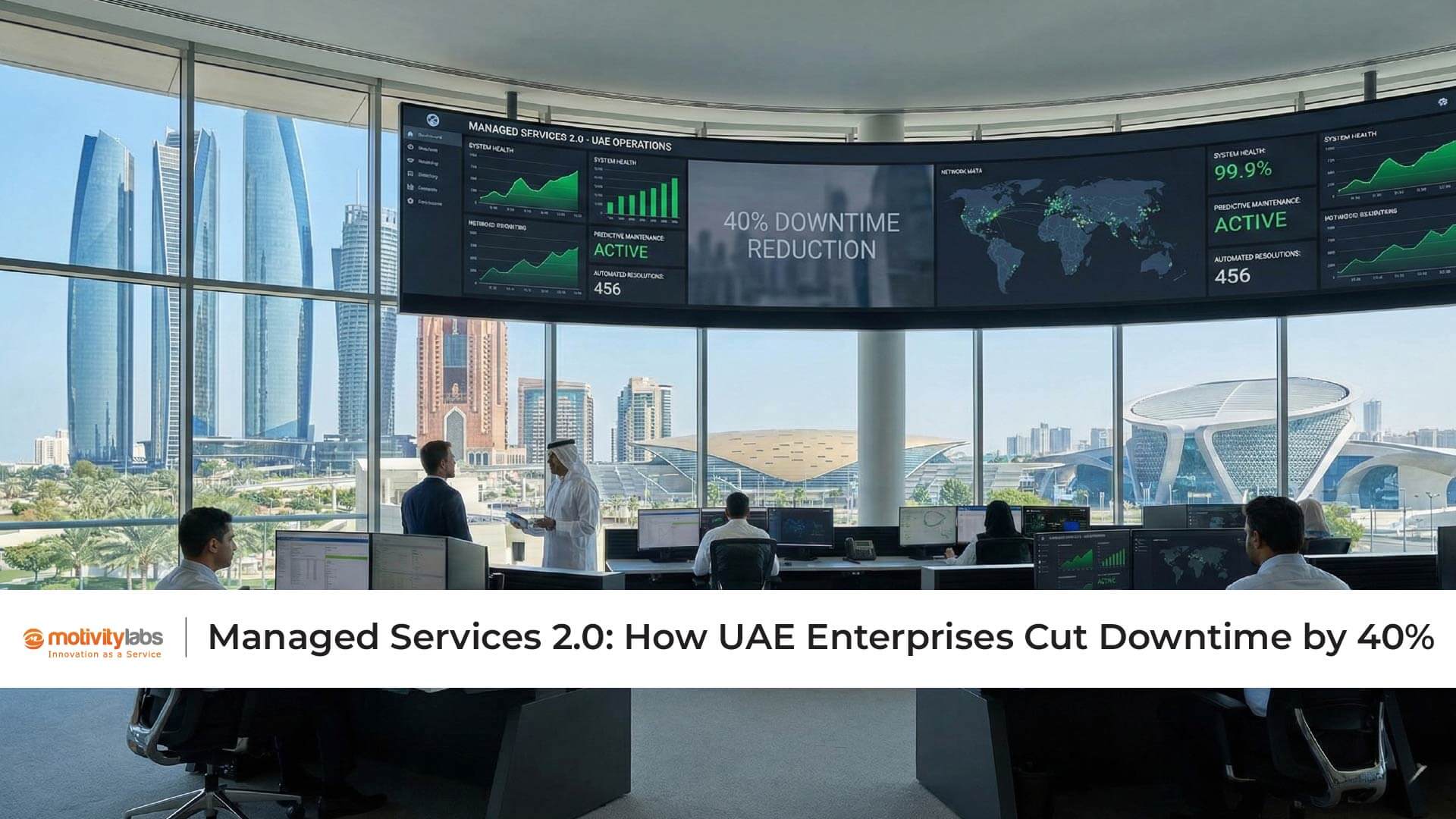
Why does downtime still catch enterprises off guard?
If enterprise IT has become more automated, cloud-first, and data-driven than ever, why does downtime still feel like an unpleasant surprise?
For many UAE enterprises, outages don’t arrive with sirens. They creep in quietly-through overloaded systems, unnoticed configuration drift, or incidents that escalate faster than teams can respond.
In a region pushing rapid UAE digital transformation, the tolerance for disruption is shrinking. Business leaders are no longer asking whether IT should be resilient-they’re asking why it isn’t already. This is where Managed Services 2.0 enters the conversation, reshaping how organizations think about uptime, accountability, and scale.
The real cost of downtime in modern enterprises
Downtime is no longer just an IT problem-it’s a boardroom issue. According to industry research, 90% of firms now estimate hourly downtime costs above USD 300,000, a figure that underscores how deeply IT availability is tied to revenue, reputation, and customer trust.
In the UAE, where sectors like telecom, banking, logistics, and government services operate at a massive scale, even minutes of disruption can ripple across ecosystems. Traditional IT Managed Services UAE models-reactive, ticket-driven, and siloed-were never designed to handle this level of complexity.
Enterprises need more than support. They need foresight.
From traditional managed services to Managed Services 2.0 What changed?
Classic Enterprise Managed Services focused on keeping systems running. Managed Services 2.0 focuses on keeping businesses running.
This shift is defined by:
- Outcome ownership instead of activity tracking
- Continuous intelligence instead of periodic checks
- Automation-first operations instead of manual escalation
In the UAE, organizations adopting Managed Services UAE frameworks aligned to outcomes are seeing measurable results-most notably, significant IT downtime reduction driven by predictive and proactive capabilities.
The pillars of Managed Services 2.0
Proactive IT monitoring replaces reactive firefighting
Modern environments generate massive telemetry from applications, networks, clouds, and endpoints. Proactive IT monitoring uses this data to identify anomalies before users feel the impact.
Instead of waiting for alerts triggered by failure, systems detect early warning signals: unusual latency, memory leaks, traffic spikes, or performance degradation. This shift alone changes IT from a responder to a guardian.
Predictive incident management changes the timeline
In Managed Services 2.0, incidents are anticipated-not just resolved. Predictive incident management uses historical patterns and real-time signals to forecast failures and recommend corrective actions automatically.
AI-enabled predictive maintenance has shown it can reduce maintenance costs by up to 30% and cut unplanned downtime by 45%, proving that prevention is no longer theoretical-it’s operational.
Cloud-first thinking enables cloud operations optimisation
As enterprises expand across hybrid and multi-cloud environments, visibility becomes fragmented. Cloud operations optimisation brings governance, performance tuning, and cost efficiency under a single operational lens.
This is particularly critical for Cloud Managed Services UAE, where enterprises must balance scale, compliance, and performance across regions and providers-without slowing innovation.
24x7 NOC services become intelligence hubs
Modern 24×7 NOC services are no longer passive monitoring centers. They function as real-time intelligence hubs-combining observability, automation, and decision engines to respond instantly when thresholds are breached.
The result is faster mean-time-to-detect (MTTD), lower mean-time-to-resolve (MTTR), and stronger IT infrastructure resilience across business-critical systems.
SLA-driven service delivery aligns IT with business outcomes
Managed Services 2.0 reframes SLAs. Instead of measuring response times alone, SLA-driven service delivery focuses on uptime, performance consistency, and user experience.
This outcome-based approach ensures IT success is measured the same way business success is-through impact, not activity logs.
The role of GenAI in Managed Services 2.0
From automation to orchestration
One of the most transformative shifts in GenAI in managed services is the move from rule-based automation to intelligent orchestration.
UAE telecom operators are already piloting Generative AI orchestration to automate network management, achieving a ~40% reduction in model-deployment time. This approach uses intelligent agents to coordinate complex workflows-monitoring, remediation, configuration, and optimization-without constant human intervention.
The takeaway is clear: GenAI doesn’t replace operations teams; it amplifies them.
Why UAE enterprises are adopting outcome-based managed services faster
Several factors make the UAE uniquely positioned for Managed Services 2.0 adoption:
- Aggressive digital-first mandates
- High customer experience expectations
- Cloud-native expansion across industries
- Regulatory pressure for reliability and compliance
As a result, Outcome-based Managed Services are becoming the default, not the exception. Enterprises no longer want vendors who manage tickets-they want partners who manage risk, continuity, and growth.
How Motivity Labs enables Managed Services 2.0
Motivity Labs approaches Managed Services 2.0 with a clear philosophy: predict, prevent, and perform.
What sets the approach apart?
- Intelligent observability across applications, infrastructure, and cloud environments
- AI-driven predictive insights that surface risks before they escalate
- Integrated NOC and cloud operations designed for scale and compliance
- Outcome-aligned SLAs focused on uptime, performance, and business continuity
By combining deep engineering expertise with automation and GenAI-led orchestration, Motivity Labs helps enterprises move from reactive support to resilient operations-supporting sustained IT downtime reduction across complex environments.
More importantly, the focus remains on enabling business velocity, not just technical stability.
Managed Services 2.0 as a growth enabler, not a cost center
When downtime drops, something else rises: confidence.
Teams ship faster. Customers experience fewer disruptions. Leaders spend less time firefighting and more time planning. In this sense, Managed Services 2.0 becomes an accelerator of UAE digital transformation, not merely an operational safeguard.
Enterprises that treat managed services as strategic infrastructure-not outsourced maintenance—are the ones redefining resilience.
The future outlook: where Managed Services UAE is headed
Looking ahead, Managed Services 2.0 will continue to evolve along three dimensions:
- Deeper AI autonomy
GenAI agents will move from assisting decisions to executing them within defined guardrails. - Unified operations across cloud and edge
As edge computing grows, managed services will expand beyond centralized data centers. - Experience-driven SLAs
Success will be measured less by uptime alone and more by business experience and continuity.
For UAE enterprises navigating rapid scale and complexity, the question is no longer if Managed Services 2.0 is necessary-but how quickly it can be adopted.
Because in a world where downtime costs hundreds of thousands per hour, resilience isn’t optional. It’s strategic.