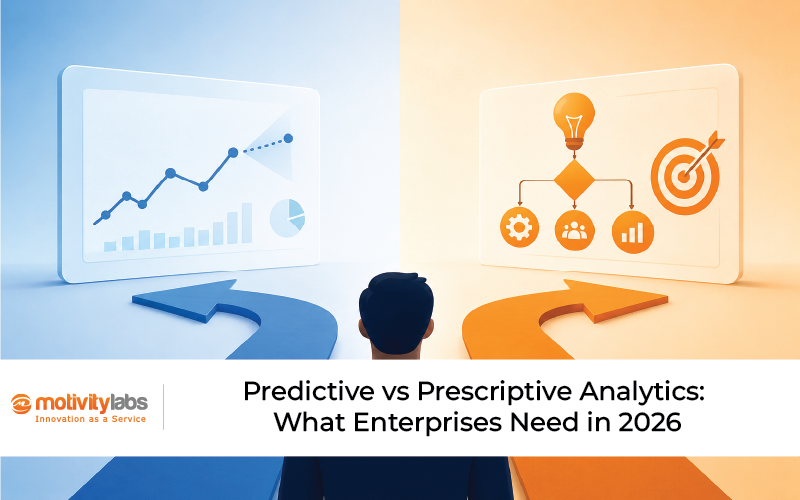
Are Enterprises Still Satisfied with Knowing What Will Happen Next?
For years, predictive analytics has been the gold standard of data-driven decision-making. Businesses have invested heavily in machine learning models, forecasting tools, and predictive dashboards to answer one critical question:
What is likely to happen next?
But in 2026, that question alone is no longer enough.
Modern enterprises operate in an environment defined by real-time data, rapidly changing customer expectations, supply chain volatility, and increasing competitive pressure. Knowing that demand may rise next month or that a customer is likely to churn is valuable, but what action should the business take?
This is where the conversation is shifting from predictive analytics to prescriptive analytics.
The organizations gaining the greatest advantage today are not merely predicting outcomes; they are using data and AI to recommend, automate, and optimize decisions.
Understanding Predictive Analytics
Predictive analytics uses historical data, statistical models, and machine learning algorithms to forecast future outcomes.
It helps organizations answer questions such as:
- Which customers are likely to churn?
- What will sales look like next quarter?
- Which equipment is at risk of failure?
- How much inventory will be needed next month?
Predictive analytics has become a core capability across industries because it helps reduce uncertainty and improve planning.
For example, retailers use predictive models to forecast demand, financial institutions predict credit risk, and manufacturers anticipate equipment maintenance requirements.
The strength of predictive analytics lies in its ability to identify patterns and probabilities before events occur.
However, predictive analytics has a limitation.
It tells organizations what could happen, but it does not necessarily tell them what they should do next.
What Is Prescriptive Analytics?
Prescriptive analytics takes data-driven decision-making a step further.
According to Gartner, prescriptive analytics is a form of advanced analytics that answers the question:
“What should be done?” or “How can a desired outcome be achieved?”
Rather than stopping at predictions, prescriptive analytics evaluates multiple scenarios and recommends the best course of action.
It combines technologies such as:
- Artificial Intelligence (AI)
- Machine Learning (ML)
- Optimization algorithms
- Simulation models
- Recommendation engines
For instance:
A predictive model may identify that customer churn is likely to increase by 15%.
A prescriptive model goes further by recommending:
- Which customers should receive retention offers
- What type of offer should be provided
- When the offer should be delivered
- Which action is likely to generate the highest ROI
In essence, predictive analytics informs decisions, while prescriptive analytics helps make them.
Why 2026 Is a Turning Point
The rise of AI is dramatically changing how enterprises use data.
Organizations are generating more information than ever before. According to IDC, the global datasphere is expected to reach approximately 175 zettabytes by 2025, while some industry estimates project data volumes approaching 181–200 zettabytes.
IDC also forecasts annual data creation growth of more than 24% CAGR between 2023 and 2028.
The challenge is no longer collecting data.
The challenge is making decisions fast enough to create value from it.
Gartner highlights that the purpose of data and analytics is to help organizations improve decision outcomes.
As enterprises adopt AI-driven operations, decision speed is becoming a competitive differentiator. Organizations increasingly need systems capable of recommending actions in real time rather than simply generating forecasts
Predictive Analytics vs Prescriptive Analytics
Predictive Analytics
Focus: What is likely to happen?
Output: Forecasts and probabilities
Primary Goal: Reduce uncertainty
Examples:
- Sales forecasting
- Customer churn prediction
- Fraud detection
- Predictive maintenance
Prescriptive Analytics
Focus: What should we do?
Output: Actionable recommendations
Primary Goal: Optimize outcomes
Examples:
- Dynamic pricing decisions
- Inventory optimization
- Workforce scheduling
- Marketing campaign optimization
The difference may seem subtle, but the business impact is significant.
Predictive analytics helps leaders understand future possibilities.
Prescriptive analytics helps them choose the best response.
Where Prescriptive Analytics Delivers the Most Value
Supply Chain Optimization: Supply chains have become increasingly complex and vulnerable to disruptions.Predictive analytics can forecast demand fluctuations.Prescriptive analytics can recommend optimal inventory levels, supplier selections, transportation routes, and replenishment schedules.
Customer Experience Management: Predictive models can identify customers at risk of leaving.Prescriptive systems can determine the best retention strategy based on customer behavior, preferences, and lifetime value.
Financial Planning:Finance teams have traditionally relied on forecasting models.Prescriptive analytics enhances planning by recommending resource allocations, investment priorities, and risk mitigation strategies.
Manufacturing and Operations: Predictive maintenance identifies when equipment may fail.Prescriptive analytics recommends maintenance schedules that minimize downtime and maximize operational efficiency.
The Role of AI in Prescriptive Decision-Making
The growth of Generative AI and Agentic AI is accelerating the adoption of prescriptive analytics.
Modern AI systems can process enormous volumes of structured and unstructured data, evaluate multiple scenarios, and generate recommendations almost instantly.
IDC’s FutureScape 2026 research highlights how AI is evolving from isolated pilots to enterprise-wide transformation initiatives.
As AI capabilities mature, enterprises are increasingly moving toward decision intelligence frameworks where recommendations and actions become embedded directly into workflows.
This shift reduces decision latency and allows organizations to respond faster to market changes.
What Enterprises Need in 2026
The debate is no longer about choosing predictive analytics or prescriptive analytics.
Enterprises need both.
Predictive analytics remains essential for forecasting future outcomes.
Prescriptive analytics transforms those insights into action.
The most successful organizations will combine prediction, optimization, and automation into a unified decision-making ecosystem.
Companies that stop at forecasting may understand the future.
Companies that embrace prescriptive analytics will be better positioned to shape it.
Future Outlook
As enterprises continue their AI transformation journeys, analytics will evolve from reporting and forecasting toward autonomous decision support.
The next generation of enterprise intelligence will not simply tell leaders what happened or what may happen next. It will recommend actions, simulate outcomes, and increasingly automate decisions in real time.
By 2026 and beyond, competitive advantage will belong to organizations that can move from insight to action faster than their competitors.
Predictive analytics will remain the foundation. Prescriptive analytics will become the differentiator.
The future of analytics is not just about predicting outcomes, it is about engineering better ones.


