Technology in education has always been a contentious point. On one hand, there are the naysayers who argue against technology because it makes students lazy and dependent. Those in favor argue that technology makes students work smarter.
Regardless of your standpoint, there is one technology that has had a huge impact on education: AI-powered Optical Character Recognition (OCR).
AI-powered OCR is playing an increasingly important role in education by making printed and handwritten content easier to access, edit, and share. As learning becomes more digital, this kind of technology is becoming less of a convenience and more of a necessity.
Let’s learn about this in more detail, see how it’s used today, and explore what more it can do.
What is AI-Powered OCR?
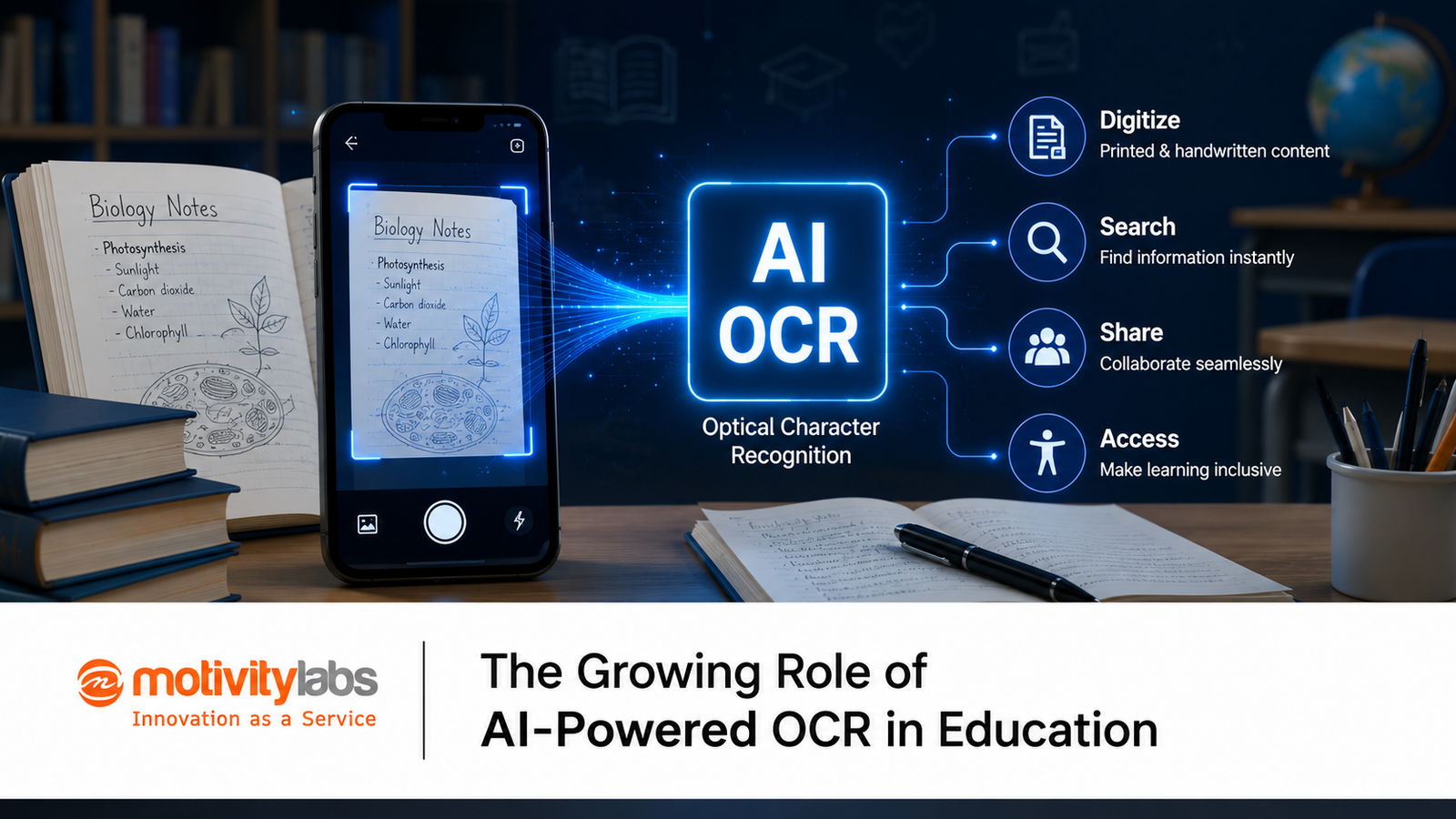
Let’s start with OCR. OCR stands for Optical Character Recognition. It is a technology that enables computers to analyze images and recognize that they are not just arrays of pixels but contain real text. Subsequently, they recognize the text and extract it into a machine-readable format supported by word processors.
Traditional OCR tools could recognize printed characters, but they often struggled with accuracy, formatting, and handwriting.
With AI, OCR tools have become much more advanced. They can now recognize different fonts, interpret handwriting, and even understand the structure and format of documents. This makes them far more reliable for real-world educational use.
Even free OCR models like Tesseract, which have the lowest accuracy among popular OCR engines, still boast an impressive 88%–94% accuracy across varied tests, including handwritten text.
How is OCR Being Used in Education Today?
AI-powered OCR is already being used in several practical ways across classrooms and learning environments. Let’s look at how it’s helping students and educators.
Converting Printed Material into Digital Content
One of the biggest benefits of OCR is that students and teachers can easily digitize printed material. Whether it’s textbooks, handwritten notes, exercise sheets, or even whiteboard annotations, simply capturing an image and processing it through an OCR tool is enough to convert it into editable digital text.
Commonly referred to as image-to-text converters, these tools are fast, easy to use, and significantly reduce the time spent manually typing information. Digital notes are easier to store, search, edit, organize, and share, making them far more useful than paper-based documents.
Supporting Remote and Digital Learning
As remote and hybrid learning continue to grow, technologies that bridge physical and digital resources have become increasingly valuable.Teachers can easily share infographics, handwritten notes, annotated diagrams, and scanned worksheets through email or virtual classrooms. Students can then use OCR to extract the text and incorporate it into their own study material.
This shift reflects the growing adoption of digital learning worldwide. Some notable trends include:
- Over 60% of U.S. colleges offer blended (hybrid) learning programs.
- Approximately 75% of K-12 schools have planned to operate either online or through hybrid learning models.
Source: Wooclap
Helping with Note-Taking and Organization
Handwritten notes are often difficult to organize and impossible to edit without rewriting them.OCR eliminates this challenge by converting handwritten notes into editable digital documents. Students can reorganize, highlight, search, and revise their notes without starting from scratch.
Improving Accessibility
AI-powered OCR plays a significant role in making education more inclusive.Students with visual impairments can use OCR-enabled applications to convert printed material into speech or enlarge digital text for better readability. This enables equal access to textbooks, assignments, and classroom resources.
Research dating back to 2014 demonstrated that smartphones equipped with OCR and screen readers could effectively help visually impaired users read printed text simply by capturing a photograph.
Beyond Recognition: Turning Text into Intelligence
While AI-powered OCR has made it easier to digitize printed and handwritten content, extracting text is only the first step. The real opportunity lies in transforming that text into meaningful insights and automated workflows.
At Motivity Labs, we believe AI-powered OCR delivers its greatest impact when combined with Intelligent Document Processing (IDP), Artificial Intelligence, Machine Learning, Cloud Services, and Workflow Automation.
Instead of simply converting documents into editable text, educational institutions can automate student admissions, streamline document verification, digitize examination records, organize research archives, simplify administrative processes, and make academic content more searchable, secure, and accessible.
By integrating OCR into a broader AI ecosystem, institutions can reduce manual effort, accelerate decision-making, improve collaboration, and unlock valuable insights from large volumes of academic data. As education continues to embrace digital transformation, Motivity Labs helps organizations move beyond document digitization and build smarter, more connected learning environments powered by AI.
Benefits for Students and Educators
The growing use of AI-powered OCR offers several advantages:
- Saves time by eliminating the need to manually type notes or documents.
- Improves accuracy while converting printed and handwritten text into editable formats.
- Makes learning materials easier to organize, search, and manage.
- Enables faster collaboration by simplifying content sharing.
- Enhances accessibility for students with different learning needs.
- Supports digital and hybrid learning environments.
Challenges to Consider with OCR
Despite its advantages, AI-powered OCR is not perfect.
Accuracy can still vary depending on image quality, lighting conditions, handwriting style, and document complexity. Although AI has significantly improved handwriting recognition, it cannot guarantee perfect accuracy in every scenario.
Another limitation is that many OCR solutions rely on cloud-based processing, requiring a stable internet connection. This raises privacy concerns when handling confidential educational documents. While offline OCR solutions exist, they generally require greater computational resources, making them less practical for mobile devices.
Understanding these limitations helps institutions choose the right OCR solution for their specific needs.
Future Outlook: What's Next for AI-Powered OCR?
The future of AI-powered OCR extends far beyond text recognition. As Generative AI and Intelligent Automation continue to evolve, OCR is becoming a key component of smarter educational ecosystems.
In the coming years, AI-powered OCR is expected to enable real-time lecture transcription, multilingual document translation, automated content summarization, AI-assisted grading, intelligent search across academic repositories, and seamless integration with Learning Management Systems (LMS).
Combined with predictive analytics and intelligent document processing, OCR will help educational institutions automate repetitive administrative tasks while creating more personalized, accessible, and data-driven learning experiences. Rather than simply digitizing information, the next generation of OCR solutions will transform educational content into actionable knowledge.
In the End
AI-powered OCR has become an essential technology in modern education. It improves the accuracy of document digitization, reduces manual effort, enhances collaboration, and makes educational content more accessible to students with diverse learning needs.
As educational institutions continue their digital transformation journey, OCR will evolve from a simple text recognition tool into a strategic enabler of intelligent learning environments. Organizations that combine OCR with AI, automation, and advanced analytics will be better positioned to improve operational efficiency, accessibility, and student outcomes.
FAQs
- What is AI-powered OCR in education?
AI-powered OCR (Optical Character Recognition) uses Artificial Intelligence to convert printed and handwritten educational content into editable, searchable digital text, improving accuracy, accessibility, and document digitization.
- How does AI-powered OCR benefit students?
Students use AI-powered OCR to convert handwritten notes and printed materials into searchable digital documents, making studying, organization, and collaboration easier.
- How are educational institutions using AI-powered OCR?
Educational institutions use AI-powered OCR to digitize student records, automate admissions, process exams, and improve accessibility.
- What are the challenges of using OCR in education?
Common OCR challenges include poor image quality, difficult handwriting, internet dependency, and data privacy concerns.
- What is the future of AI-powered OCR in education?
AI-powered OCR is shaping the future of education through intelligent document processing, automation, and AI-driven learning.