For the better part of the last two decades, our interaction with technology has followed a familiar pattern. We pulled our phones out of our pockets, opened an app, searched for information and put the device away. The relationship was intentional; we chose when to engage with technology.
AI is changing that equation. The next wave of AI innovation is about creating technology that is constantly present, continuously aware and seamlessly integrated into our daily lives. This new era, often referred to as ambient computing, is bringing AI out of our phones and onto our faces through AI wearables such as smart glasses.
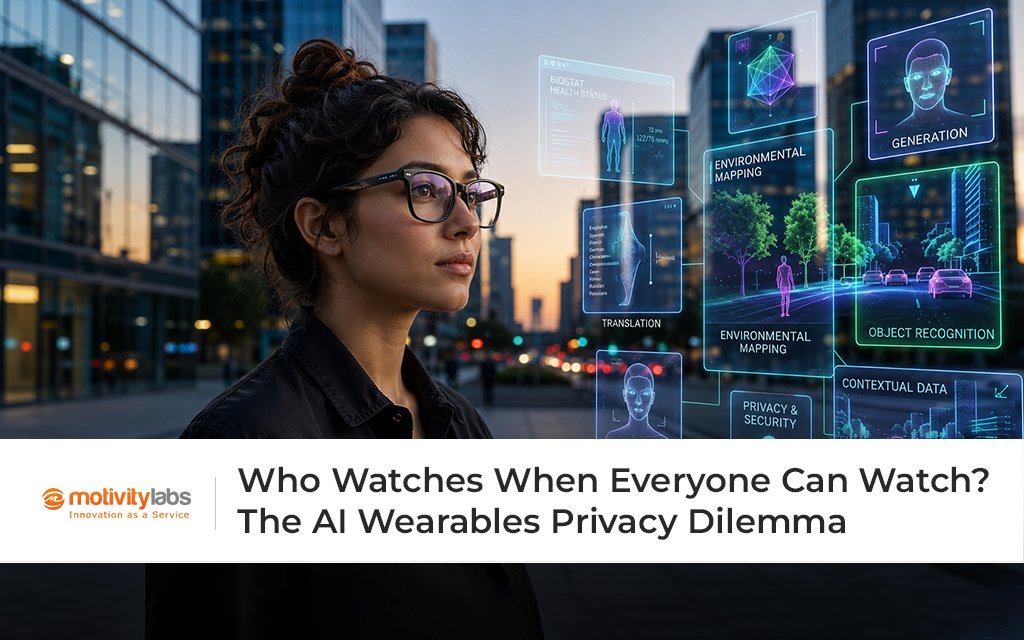
What was once considered a futuristic concept is now becoming a mainstream consumer product. AI-powered glasses can answer questions about the world around us, translate conversations in real time, identify landmarks, recognize objects, summarize what users are seeing, provide navigation without looking at a phone, and even remember where someone left their keys. This promises a future where technology feels almost invisible.
Yet the same innovation that makes AI wearables remarkably useful also raises one uncomfortable question:
If everyone can watch through AI, who is watching whom?
As cameras, microphones, and intelligent assistants become everyday accessories rather than handheld devices, society is entering unfamiliar territory where convenience, privacy, and trust are beginning to collide.
The Rise of AI Wearables: Why Big Tech Is Betting on Smart Glasses
The growing excitement around AI wearables is far from accidental. It reflects a larger shift in how technology companies envision the future of computing.
Over the last few years, Gen AI has demonstrated that intelligent systems can understand language, images, audio, and context with surprising accuracy. The natural next step is to remove the friction of typing prompts or opening applications altogether. Instead of interacting with AI through a screen, users interact with it naturally through speech, vision, and their surrounding environment.
Meta’s Ray-Ban Smart Glasses have emerged as one of the strongest examples of this vision. Initially launched as an extension of wearable photography, the product has evolved into a sophisticated AI assistant capable of identifying objects, translating conversations, answering contextual questions, playing music, capturing photos and videos, and providing real-time assistance using Meta AI.
This is precisely why companies like Meta, Google, and now reportedly Apple are investing heavily in AI-powered smart glasses.
Meta’s Ray-Ban Smart Glasses have emerged as one of the strongest examples of this vision. Initially launched as an extension of wearable photography, the product has evolved into a sophisticated AI assistant capable of identifying objects, translating conversations, answering contextual questions, playing music, capturing photos and videos, and providing real-time assistance using Meta AI.
Apple’s reported plans to introduce AI smart glasses around 2027 further reinforce this momentum. While Apple has yet to officially confirm the product, multiple industry reports suggest that the company sees AI glasses as a long-term successor, or at least a powerful companion, to smartphones.
This competition is about far more than glasses. It represents the race to own the next interface between humans and Artificial Intelligence.
Why AI Wearables Are Gaining Popularity
Imagine walking through a foreign city where your glasses translate street signs and conversations instantly. Picture a visually impaired individual receiving spoken descriptions of their surroundings in real time. Consider a field engineer who can access repair manuals without putting down their tools or a healthcare professional who can retrieve patient information hands-free while remaining focused on treatment.
The possibilities extend well beyond consumer convenience.
For enterprises, AI wearables could improve workforce productivity by providing contextual information exactly when employees need it. Logistics workers could receive navigation assistance inside warehouses. Manufacturing technicians could troubleshoot machinery using AI-guided instructions. Retail associates could instantly access product information while assisting customers. Emergency responders could obtain building layouts or hazard information without looking away from critical situations.
In many ways, AI wearables represent the convergence of Generative AI, computer vision, augmented reality, and voice computing into a single interface.
From Smart Glasses to "Pervert Glasses": Understanding the Public Backlash
Perhaps the clearest reflection of this discomfort has emerged on social media.
Across platforms such as Reddit, TikTok, and X (formerly Twitter), some users have mockingly referred to AI smart glasses as “pervert glasses.” The phrase has gained attention not because it accurately represents the technology itself, but because it captures a growing public anxiety about invisible surveillance and diminishing personal privacy.
The nickname for Meta Ray-Ban Smart Glasses reflects a broader concern: when recording devices become nearly indistinguishable from ordinary eyewear, people may struggle to determine whether they are simply part of someone’s field of vision or part of a digital recording.
Women, in particular, have voiced concerns about the potential misuse of wearable cameras in gyms, cafés, shopping centres, public transport, beaches, and other public spaces where unwanted recording has long been a societal issue. Privacy advocates have similarly questioned whether existing laws, many of which were written before AI-powered wearables became viable, are equipped to address these emerging challenges.
Importantly, the backlash is not directed solely at Meta. It reflects a wider discomfort with a future in which cameras, microphones, and AI assistants become continuously present in everyday life.
The debate therefore extends beyond one product or one company.
As AI wearables become increasingly sophisticated, this question will only become more urgent.
AI Doesn't Just Record, It Understands
The privacy concerns surrounding AI wearables extend far beyond the presence of a camera. Smartphones, action cameras, and traditional wearables have captured images and videos for years. What makes AI-powered smart glasses fundamentally different is their ability to interpret the world around them.
Modern AI wearables combine computer vision, natural language processing, speech recognition, and contextual reasoning to transform raw visual information into meaningful insights.
The convenience is undeniable. Yet it also raises a new category of privacy concerns.
The debate is about whether AI is continuously observing, analyzing, interpreting, and potentially storing information about people who never agreed to participate. A casual conversation, a confidential business discussion, or even a stranger walking down the street could inadvertently become part of an AI system’s contextual understanding.
As AI grows more capable, the line between observation and interpretation becomes increasingly blurred.
Convenience Comes at the Cost of Consent
Privacy has always been built on the principle of informed consent. People generally understand when they are being photographed or recorded because the action is visible. Smartphones are raised. Cameras are pointed. Recording devices are noticeable.
AI wearables challenge that social convention.
A pair of ordinary-looking glasses equipped with cameras and AI assistants can perform sophisticated functions without attracting attention. Although manufacturers such as Meta have incorporated LED recording indicators and established usage guidelines, critics argue that these signals may not always be obvious in busy public environments.
This uncertainty creates a trust gap.
For many people, the concern is not whether AI companies intend to misuse the technology. Rather, it is whether society has had sufficient time to establish new norms around devices that are capable of persistent perception. Questions around consent become especially relevant in schools, hospitals, workplaces, public transportation, gyms, and other environments where expectations of privacy differ.
Technology often evolves faster than legislation. AI wearables appear to be another example where innovation is advancing more rapidly than regulatory frameworks designed to govern it.
So, Should You Embrace AI Wearables?
The answer is unlikely to be a simple yes or no.
Like every transformative technology before them, AI wearables offer tremendous opportunities alongside equally significant responsibilities.
For consumers, the technology promises greater convenience, accessibility, productivity, and personalized assistance. Real-time language translation can remove communication barriers while traveling. Context-aware AI can simplify navigation, assist individuals with visual impairments, and make everyday tasks more efficient.
For enterprises, the potential is even greater. AI Smart Glasses can empower frontline workers, improve operational efficiency, enhance remote collaboration, support predictive maintenance, and enable hands-free access to critical information in manufacturing, healthcare, logistics, retail, and field services.
However, widespread adoption should not come at the expense of trust.
Organizations developing AI-powered devices must prioritize privacy by design, transparent data policies, secure AI architectures, and responsible data governance. Consumers, in turn, must understand how these systems collect, process, and retain information before integrating them into their daily lives.
Innovation succeeds when people trust it.
Without trust, even the most advanced technologies struggle to achieve long-term acceptance.
Building Responsible AI Wearables: The Role of Enterprise Innovation
The debate surrounding AI wearables highlights a broader truth about Artificial Intelligence itself. Building smarter AI systems is no longer enough. Organizations must also build systems that are transparent, secure, explainable, and aligned with evolving regulatory expectations.
This is where enterprises have an important role to play.
As AI moves beyond chatbots and enters the physical world through wearable devices, businesses must rethink how they design digital experiences. Responsible AI frameworks, secure cloud infrastructure, edge AI processing, privacy-first architectures, and robust governance mechanisms will become essential for balancing innovation with public trust.
At Motivity Labs, we believe the future of AI will not be defined solely by how intelligent systems become, but by how responsibly they are designed and deployed. Whether organizations are exploring AI wearables, intelligent automation, computer vision, or Agentic AI, success will depend on creating solutions that prioritize user trust alongside technological advancement.
Our expertise in AI, cloud engineering, digital transformation, enterprise applications, and data-driven innovation enables organizations to build scalable AI ecosystems that are secure, compliant, and prepared for the next generation of intelligent experiences.
Because the future of AI is not just about what technology can do.
It is about what society is willing to embrace.
Conclusion
The rise of AI wearables marks one of the most significant shifts in personal computing since the smartphone revolution. Meta’s success with Ray-Ban smart glasses and Apple’s reported interest in entering the market suggest that AI-powered eyewear is rapidly moving from experimental technology to mainstream consumer innovation.
Yet this transformation also introduces profound questions about privacy, consent, surveillance, and trust. Unlike previous generations of technology, AI wearables are designed to become invisible companions, constantly observing, understanding, and assisting users throughout their daily lives.
That capability is both their greatest strength and their greatest challenge.
The future of AI wearables will not be determined solely by advances in hardware or artificial intelligence. It will depend on whether technology companies, policymakers, enterprises, and consumers can collectively establish new standards for responsible innovation.
The question is no longer whether AI will become wearable.
The real question is whether we can build a future where AI remains both intelligent and trustworthy.
Because when everyone can watch, trust becomes the most valuable technology of all.