Agentic AI in Action: Automating Complex Workflows at Scale
For years, enterprises have relied on automation to handle repetitive tasks, streamline workflows, and improve operational efficiency. But what if automation
What Happens When AI Stops Assisting and Starts Acting?
For years, enterprises have relied on automation to handle repetitive tasks, streamline workflows, and improve operational efficiency. But what if automation could go a step further? What if systems could independently reason, make decisions, adapt to changing conditions, and execute end-to-end business processes with minimal human intervention?
That is exactly where Agentic AI is changing the game.
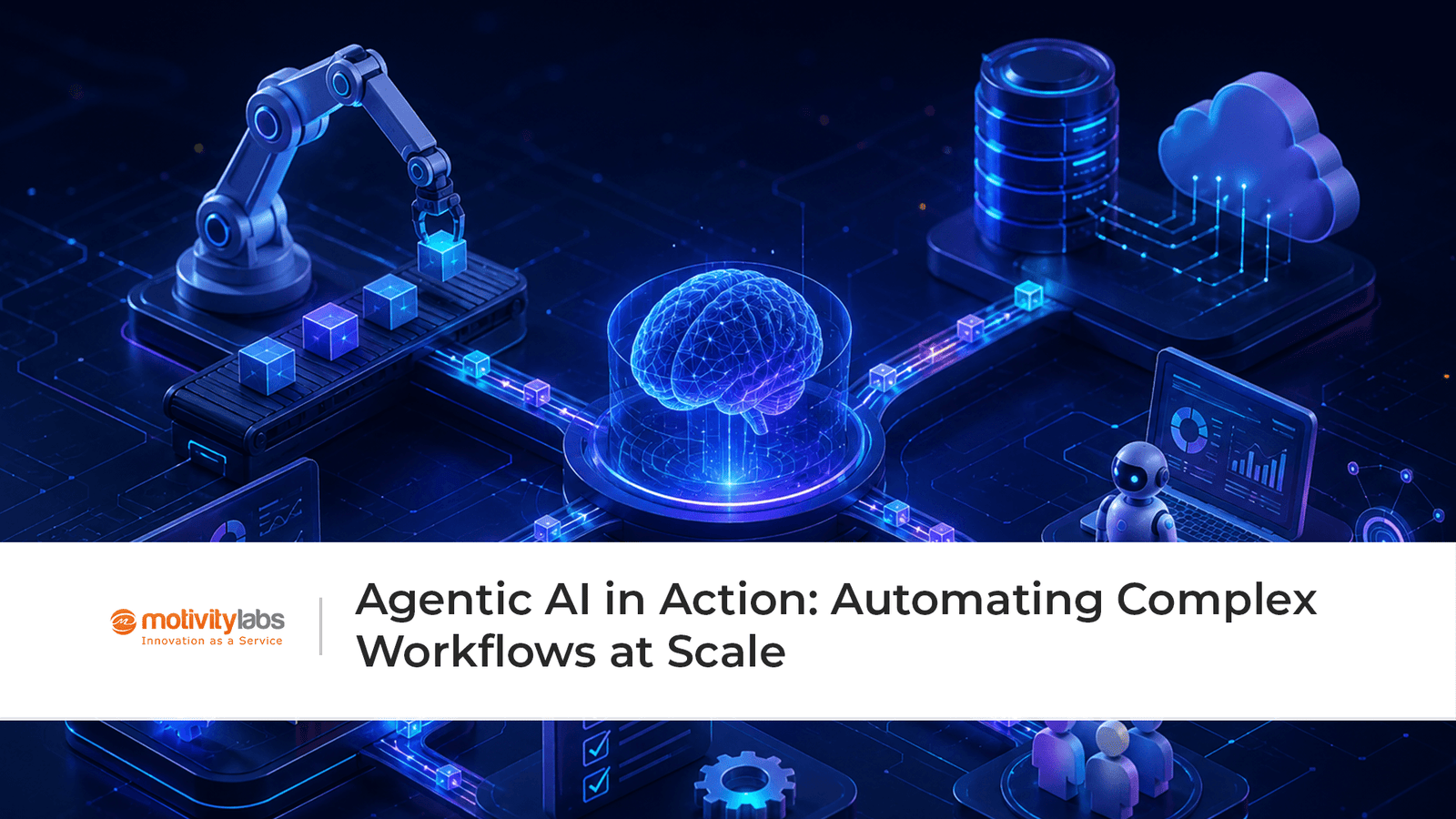
Unlike traditional AI models that respond to prompts or generate content based on user input, Agentic AI systems are designed to act autonomously toward specific goals. These intelligent agents can analyze context, collaborate across systems, trigger actions, and continuously optimize workflows in real time.
The momentum behind this transformation is accelerating rapidly. According to McKinsey’s State of AI 2025 report, nearly 62% of organizations are already experimenting with AI agents, while 23% have started scaling them across enterprise environments.
This shift signals more than just another wave of digital transformation. It marks the transition from AI as a support tool to AI as an active operational participant.
As enterprises deal with increasing workflow complexity, fragmented systems, and rising demands for speed and personalization, Agentic AI is emerging as the foundation for scalable intelligent automation.
Understanding Agentic AI: Beyond Conventional Automation
Traditional automation solutions follow predefined rules. Robotic Process Automation (RPA), for example, excels at repetitive, structured tasks but struggles when workflows become dynamic or unpredictable.
Agentic AI operates differently.
It combines large language models (LLMs), reasoning engines, workflow orchestration, machine learning, memory systems, and tool integration to create AI agents capable of independently completing complex objectives.
Instead of waiting for instructions at every step, these systems can:
- Interpret goals
- Break down multi-step tasks
- Access enterprise tools and databases
- Collaborate with other agents
- Adapt decisions in real time
- Learn from outcomes
For example, an AI-powered supply chain agent can detect shipment delays, analyze inventory availability, coordinate with logistics systems, notify stakeholders, and recommend alternative sourcing strategies – all without continuous human oversight.
This evolution is redefining how enterprises approach business process automation.
According to McKinsey, organizations that redesign workflows around AI agents are seeing significantly greater efficiency and operational gains compared to companies using AI only for isolated tasks.
Why Enterprises Are Turning Toward Agentic AI
Modern enterprises operate in highly interconnected environments where workflows span multiple applications, departments, and data ecosystems. Managing these workflows manually creates inefficiencies, delays, and operational bottlenecks.
Agentic AI addresses these challenges by introducing intelligent orchestration at scale.
Handling Workflow Complexity: Enterprise workflows are no longer linear. A customer onboarding process, for instance, may involve CRM systems, compliance checks, document verification, fraud analysis, approvals, and customer communication. Traditional automation struggles when exceptions or dynamic decisions arise. Agentic AI agents can reason through these variations and adjust workflows autonomously. As businesses adopt more connected systems, software marketplace platforms make it easier to identify solutions that support intelligent, end-to-end workflow automation.
Faster Decision-Making : Businesses today operate in real time. Whether it is responding to customer queries, resolving IT incidents, or managing inventory disruptions, delays can directly impact revenue and customer experience.Agentic AI enables faster, context-aware decisions by continuously analyzing data streams and initiating actions instantly.
Operational Scalability: As organizations grow, workflow complexity increases exponentially. Scaling manual operations becomes unsustainable.Agentic AI introduces scalable intelligent operations by automating decision-making across departments without requiring proportional increases in workforce or operational overhead.
Improved Human Productivity: Rather than replacing employees, Agentic AI is increasingly being used to augment human capabilities.Gartner research highlights that organizations investing in workforce upskilling alongside AI adoption are achieving stronger returns than companies relying solely on workforce reduction strategies. This collaborative model allows employees to focus on strategic, creative, and customer-centric work while AI agents handle repetitive and operationally intensive tasks.
Key Enterprise Use Cases of Agentic AI
Agentic AI is rapidly expanding across industries and operational domains.
Intelligent Customer Support : AI agents can autonomously manage customer interactions across channels, resolve common queries, escalate complex cases, and personalize communication based on customer history and behavior.Unlike static chatbots, these systems understand intent, adapt conversations dynamically, and take actions within enterprise systems.
IT Operations and Incident Management: Modern IT environments generate massive volumes of alerts and logs. Agentic AI systems can identify anomalies, diagnose root causes, initiate remediation workflows, and notify relevant teams automatically.This significantly reduces downtime and accelerates issue resolution.
Supply Chain Optimization:Supply chains are increasingly vulnerable to disruptions caused by geopolitical events, demand fluctuations, and logistics constraints.Agentic AI enables predictive decision-making by continuously monitoring supplier performance, shipment tracking, inventory levels, and market conditions.These systems can proactively reroute shipments, optimize procurement decisions, and minimize operational disruptions.
Healthcare Workflow Automation:Healthcare organizations are leveraging Agentic AI for patient scheduling, claims processing, diagnostics support, and administrative workflow management.AI agents help reduce operational burden while improving response time and patient experiences.
Financial Services and Compliance:Banks and financial institutions are deploying Agentic AI for fraud detection, risk assessment, regulatory reporting, and customer onboarding.These systems can analyze vast datasets in real time while ensuring compliance with evolving regulations.
The Technology Behind Agentic AI Systems
The rise of Agentic AI is being driven by advances in enterprise AI infrastructure.
Modern agentic systems typically combine:
- Large Language Models (LLMs)
- Retrieval-Augmented Generation (RAG)
- AI orchestration frameworks
- API integrations
- Multi-agent collaboration models
- Enterprise data pipelines
- Decision intelligence systems
McKinsey recently highlighted that enterprise infrastructure itself is evolving into an orchestration backbone designed specifically for agentic workflows.
This means businesses are no longer building isolated AI applications. Instead, they are creating interconnected ecosystems where multiple AI agents coordinate tasks, share context, and optimize enterprise operations collaboratively.
Challenges in Scaling Agentic AI
While the potential is enormous, scaling Agentic AI requires careful planning and governance.
Data Quality and Integration : AI agents rely heavily on real-time enterprise data. Poor data quality, fragmented systems, and disconnected workflows can limit effectiveness.Organizations need robust data engineering strategies to ensure AI systems operate reliably.
Governance and Trust: As AI agents gain autonomy, enterprises must establish governance frameworks to ensure transparency, accountability, and ethical decision-making.This includes auditability, compliance monitoring, and human oversight mechanisms.
Infrastructure Readiness: Many enterprises still lack the infrastructure required to scale Agentic AI effectively.SAP CEO Christian Klein recently noted that nearly 80% of organizations are not yet fully prepared with the infrastructure or operational maturity needed for large-scale agentic AI deployment.
Avoiding ‘Agent Washing’:The growing popularity of Agentic AI has also led to inflated claims from vendors. Gartner warns that over 40% of agentic AI projects may fail by 2027 due to unclear value propositions and immature implementations. Successful adoption requires identifying high-impact workflows where autonomous decision-making genuinely delivers measurable business outcomes.
How Motivity Labs Helps Enterprises Scale Agentic AI
At Motivity Labs, the focus is not simply on implementing AI tools but on helping enterprises build intelligent, scalable, and outcome-driven automation ecosystems.
Motivity Labs enables organizations to transition from fragmented automation to enterprise-grade Agentic AI solutions that drive operational efficiency and business agility.
AI-Powered Workflow Automation
Motivity Labs helps businesses automate complex workflows across operations, customer engagement, IT, finance, and supply chain ecosystems using intelligent AI agents.These systems are designed to orchestrate multi-step processes, integrate with enterprise platforms, and adapt dynamically to changing business conditions.
Enterprise AI Integration
One of the biggest barriers to scaling AI is system fragmentation.Motivity Labs specializes in integrating AI agents seamlessly with enterprise applications, cloud environments, APIs, CRMs, ERPs, and legacy systems to create connected intelligent operations.
Data Engineering and AI Infrastructure
Scalable Agentic AI depends on strong data foundations.Motivity Labs provides advanced data engineering, AI infrastructure modernization, and cloud-native architecture solutions that support real-time AI orchestration and enterprise scalability.
Responsible AI and Governance
As organizations deploy autonomous AI systems, governance becomes critical.Motivity Labs helps enterprises establish responsible AI frameworks that prioritize transparency, security, compliance, and operational accountability.
Custom AI Solutions
Every enterprise has unique operational challenges.Motivity Labs develops tailored AI solutions aligned with industry-specific workflows, ensuring measurable business impact rather than generic automation deployments.
The Future Outlook: The Rise of Autonomous Enterprises
Agentic AI represents the next evolution of enterprise intelligence.
Businesses are moving beyond isolated AI experiments toward fully autonomous operational ecosystems where AI agents collaborate with humans, systems, and data environments in real time.
The future enterprise will not simply automate tasks. It will orchestrate intelligent decision-making at scale.
From predictive supply chains and autonomous customer operations to intelligent finance and adaptive IT ecosystems, Agentic AI is set to redefine how organizations operate in the coming decade.
The companies that succeed will not be the ones that deploy the most AI tools. They will be the ones that redesign workflows, modernize infrastructure, and build intelligent systems capable of continuous adaptation.
As enterprises prepare for this transformation, the focus will shift from automation efficiency to operational intelligence.
And in that future, Agentic AI will not just support business operations – it will actively drive them.
Working through the same problem?
We'll map your situation with you in 30 minutes — no pitch deck.
Let's Connect