Edge Computing and Its Role in Real-Time Business Intelligence
What if the insights you rely on didn’t arrive seconds or even minutes too late? In a world where every click, transaction, and sensor generates data, the
What if your data could think before you do?
What if the insights you rely on didn’t arrive seconds or even minutes too late? In a world where every click, transaction, and sensor generates data, the real question isn’t how much data you have; it’s how fast you can act on it.
This is exactly where edge computing real-time BI starts to change the game.
Traditional business intelligence systems were built for a different era, one where data was centralized, structured, and relatively slow-moving. Today, however, data is dynamic, distributed, and generated at unprecedented speeds. In fact, the global edge computing market is projected to reach USD 111.3 billion by 2028, growing at a CAGR of over 15%, signaling a fundamental shift in how enterprises process and leverage data.
So, how does edge computing actually power real-time business intelligence—and why is it becoming indispensable?
The Shift from Centralized to Distributed Intelligence
For years, businesses relied heavily on cloud and centralized data centers to process and analyze information. While effective, this model introduces latency—data has to travel from source to server and back before any decision can be made.
But here’s the challenge: by 2025, 75% of enterprise-generated data will be created and processed outside traditional data centers or the cloud.
This shift toward distributed data processing means that relying solely on centralized systems is no longer viable. Data is now being generated at the “edge”—on devices, sensors, machines, and local systems—and it needs to be processed there as well.
This is where edge computing BI comes in.
Instead of sending all data to the cloud, edge computing processes data closer to its source. The result? Faster insights, reduced bandwidth usage, and the ability to act in real time.
Why Real-Time Analytics Needs the Edge
At the core of modern decision-making lies real-time analytics-the ability to analyze data instantly and act on it without delay.
Think about industries like:
- Manufacturing (predicting equipment failure)
- Retail (dynamic pricing and inventory updates)
- Healthcare (real-time patient monitoring)
- Logistics (route optimization and fleet tracking)
In these scenarios, even a few seconds of delay can lead to missed opportunities or costly consequences.
With edge analytics, data doesn’t need to travel far. It is processed locally, enabling low latency processing that significantly improves responsiveness.
In fact, organizations leveraging edge computing for analytics report up to a 50% reduction in latency for data processing and decision-making.
That’s not just a performance improvement-it’s a competitive advantage.
Edge vs Cloud Analytics: Complement, Not Competition
A common misconception is that edge computing will replace cloud computing. In reality, the conversation is more about edge vs cloud analytics working together.
Cloud excels at deep analysis, historical data storage, and large-scale model training
Edge excels at real-time decision-making, immediate insights, and localized processing
This hybrid approach allows businesses to:
- Process time-sensitive data at the edge
- Send aggregated insights to the cloud for deeper analysis
- Continuously improve models and predictions
This balance is what enables scalable and efficient edge computing real-time BI systems.
Unlocking Business Value: Edge Computing Benefits
So, beyond speed, what are the tangible edge computing benefits for business intelligence?
1. Faster Decision-Making: Real-time insights allow businesses to respond instantly to changing conditions.
2. Reduced Data Transfer Costs:Processing data locally minimizes the need to send large volumes to the cloud.
3. Improved Reliability: Edge systems can operate even with limited or intermittent connectivity.
4. Enhanced Data Privacy: Sensitive data can be processed locally without being transmitted across networks.
These benefits collectively make edge computing a critical enabler of digital innovation, especially in data-intensive environments.
Real-World Edge BI Use Cases
To understand the true impact, let’s look at some practical edge BI use cases:
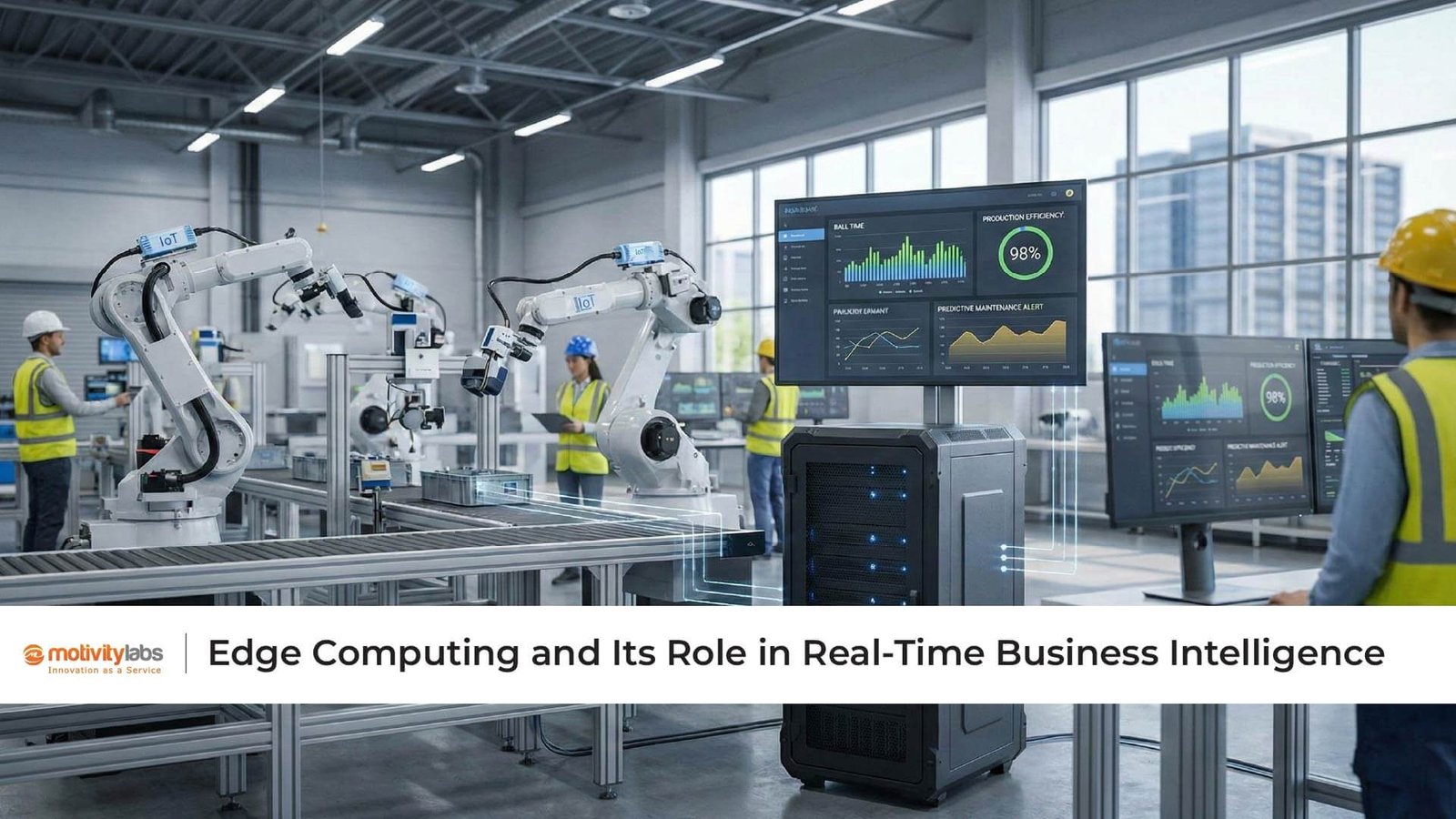
- Smart Manufacturing:Machines equipped with sensors use IoT edge analytics to monitor performance in real time, predicting failures before they occur.
- Retail Intelligence: Stores analyze customer behavior and inventory data instantly to optimize product placement and pricing.
- Healthcare Monitoring:Wearable devices process patient data at the edge, enabling immediate alerts for critical conditions.
- Logistics & Supply Chain:Fleet systems use real-time data to adjust routes, reduce fuel consumption, and improve delivery times.
Across all these industries, the common thread is clear: real-time insights drive better outcomes.
The Role of Predictive Analytics at the Edge
Edge computing isn’t just about reacting faster—it’s also about predicting smarter.
With predictive analytics edge capabilities, businesses can:
- Anticipate demand fluctuations
- Detect anomalies before they escalate
- Optimize operations proactively
By combining AI models with edge infrastructure, organizations can bring intelligence closer to where data is generated—turning raw data into actionable foresight in milliseconds.
Building the Architecture for Edge-Driven BI
Implementing edge computing BI isn’t just about deploying devices—it requires a well-thought-out architecture:
Key Components:
- Edge Devices: Sensors, IoT devices, gateways
- Edge Nodes: Local processing units
- Connectivity Layer: Enables communication between edge and cloud
- Cloud Integration: For storage, model training, and large-scale analytics
This layered approach ensures that businesses can scale their distributed data processing capabilities without compromising performance or security.
The Road Ahead: Edge as the Default Infrastructure
The momentum behind edge computing is not slowing down—it’s accelerating.
By 2026, over 50% of new enterprise IT infrastructure will be deployed at the edge rather than corporate data centers.
This shift indicates a broader transformation:
- From centralized to decentralized systems
- From batch processing to real-time intelligence
- From reactive decision-making to proactive strategies
In this evolving landscape, edge computing real-time BI will no longer be optional—it will be foundational.
Future Outlook: From Speed to Strategy
So, where does this all lead?
Edge computing is redefining how businesses think about datanot just as a resource, but as a real-time asset. As technologies like AI, IoT, and 5G continue to mature, the edge will become even more intelligent, autonomous, and integral to business operations.
In the near future, we can expect:
- Hyper-personalized customer experiences powered by instant insights
- Autonomous systems making decisions without human intervention
- Seamless integration between edge and cloud ecosystems
- Increased adoption across industries beyond early adopters
Ultimately, the question is no longer whether businesses should adopt edge computing-it’s how quickly they can integrate it into their BI strategy.
Because in a world driven by speed, the real advantage doesn’t come from having data.
It comes from acting on it-first.
Working through the same problem?
We'll map your situation with you in 30 minutes — no pitch deck.
Let's Connect