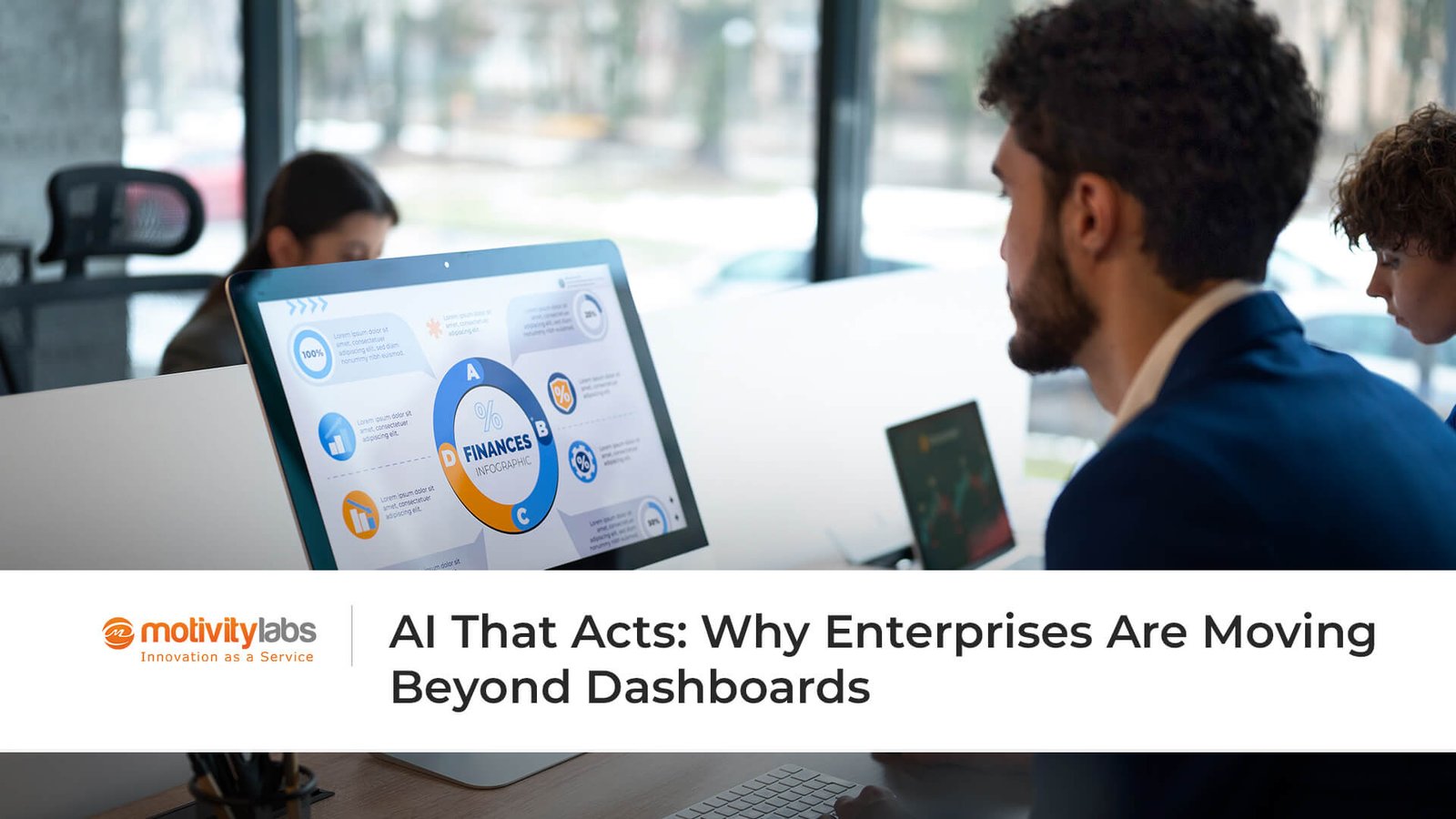
Are Dashboards Still Driving Decisions or Just Delaying Them?
What happens when insights arrive faster than decisions can be made? When dashboards are full, but action is still pending? When organizations can see everything, yet struggle to do anything in real time?
In 2026, enterprises are confronting an uncomfortable truth: dashboards, once the backbone of data-driven decision-making, are no longer enough.
The shift is underway, from AI that informs to AI that acts.
The Dashboard Era: Powerful, But Passive
For over a decade, dashboards have been central to enterprise analytics. They helped organizations:
- Visualize key performance indicators (KPIs)
- Monitor operations in near real time
- Enable data-driven decision-making
But dashboards have a fundamental limitation, they require human interpretation and intervention.
The Problem:
- Data is visualized, not operationalized
- Decisions depend on human availability and speed
- Opportunities and risks can be missed in the delay
In a world where milliseconds matter, waiting for someone to “check the dashboard” is becoming a bottleneck.
Why 2026 is the Tipping Point
The evolution of AI, automation, and real-time data processing is pushing enterprises beyond passive analytics.
- According to Gartner, over 70% of enterprises will shift from pilot AI projects to operational AI systems by 2026, embedding AI into core business processes
- A report by McKinsey & Company highlights that companies leveraging AI-driven automation can improve operational efficiency by up to 40%. These numbers signal a major transition: AI is no longer just an analytics tool-it’s becoming an execution engine.
From Insights to Action: What’s Changing?
- AI as a Decision-Maker, Not Just an Advisor
Traditional analytics answers: “What is happening?”
Modern AI answers: “What should we do and does it.”
AI systems in 2026 can:
- Trigger automated workflows
- Optimize processes in real time
- Make context-aware decisions without human input
For example:
- Supply chains auto-adjust inventory levels
- Fraud detection systems block transactions instantly
- IT systems resolve incidents autonomously
Impact: Decisions are no longer delayed; they are executed instantly.
- Real-Time Data Processing at Scale
The explosion of data, from IoT devices, applications, and digital platforms, demands real-time processing.
Dashboards struggle to keep up. AI doesn’t.
What AI Enables:
- Continuous data ingestion
- Instant anomaly detection
- Immediate response mechanisms
This is particularly critical in industries like finance, healthcare, and manufacturing—where delays can lead to significant losses.
- Autonomous Workflows: The End of Manual Intervention
AI is increasingly embedded into workflows, enabling systems to act without waiting for human approval.
Examples:
- Customer support bots resolving issues end-to-end
- Predictive maintenance systems scheduling repairs automatically
- Marketing platforms optimizing campaigns in real time
This shift reduces:
- Operational delays
- Human error
- Dependency on manual processes
- Context-Aware Intelligence
Dashboards present static data snapshots. AI understands context.
Modern AI systems can:
- Analyze patterns across multiple data sources
- Understand relationships between variables
- Adapt decisions based on changing conditions
For instance, AI in retail can:
- Adjust pricing dynamically
- Optimize inventory based on demand patterns
- Personalize customer experiences in real time
This level of intelligence goes far beyond what dashboards can offer.
- Integration Across the Enterprise Ecosystem
AI doesn’t operate in silos—it integrates across systems.
Connected Intelligence Includes:
- ERP systems
- CRM platforms
- IoT devices
- Cloud infrastructure
This creates a unified, intelligent ecosystem where decisions are:
- Data-driven
- Automated
- Scalable
The result is a seamless flow from insight to action.
Industry Use Cases: AI That Acts in the Real World
Financial Services
AI is transforming fraud detection by:
- Identifying suspicious transactions instantly
- Blocking fraudulent activity in real time
- Reducing financial risk
Manufacturing
AI-driven systems enable:
- Predictive maintenance
- Automated quality control
- Real-time production optimization
This leads to increased efficiency and reduced downtime.
Healthcare
AI is enabling:
- Real-time patient monitoring
- Automated diagnostics
- Faster clinical decision-making
This improves patient outcomes and operational efficiency.
Retail and E-Commerce
AI systems are:
- Personalizing customer journeys
- Optimizing pricing strategies
- Managing inventory dynamically
This enhances both customer experience and revenue growth.
The Technology Powering AI That Acts
Machine Learning and Deep Learning
These technologies enable AI systems to:
- Learn from historical data
- Predict future outcomes
- Improve over time
Edge Computing
Processing data closer to the source allows:
- Faster decision-making
- Reduced latency
- Enhanced privacy
Event-Driven Architectures
AI systems are increasingly built on event-driven models, where:
- Actions are triggered automatically by specific events
- Systems respond instantly to changes
Generative AI + Autonomous Agents
In 2026, generative AI is evolving into autonomous agents that can:
- Execute complex workflows
- Interact with systems and users
- Make multi-step decisions
This marks the transition from automation to autonomy.
Challenges: Why Not Everyone Has Made the Shift
Trust in AI Decisions
Organizations must:
- Ensure transparency in AI models
- Build trust in automated decisions
- Maintain human oversight where necessary
Integration Complexity
Moving beyond dashboards requires:
- Modernizing legacy systems
- Integrating AI into existing workflows
- Investing in infrastructure
Data Quality and Governance
AI systems are only as effective as the data they rely on. Poor data quality can lead to:
- Incorrect decisions
- Operational risks
Beyond Dashboards: The Rise of Actionable Intelligence
The future of enterprise technology is not about better dashboards-it’s about eliminating the need for them.
AI is transforming how organizations operate by:
- Reducing decision latency
- Automating complex processes
- Enabling real-time responsiveness
This shift is at the heart of modern digital innovation, where speed, intelligence, and automation define competitive advantage.
The Future: From Observing to Operating
We are entering an era where enterprises don’t just monitor their environments-they operate within them intelligently.
AI systems will:
- Anticipate challenges
- Take preventive actions
- Continuously optimize outcomes
Dashboards will not disappear entirely, but their role will change. They will become tools for oversight, not decision-making.
Final Thoughts
So, are dashboards becoming obsolete?
Not entirely but they are no longer the center of enterprise intelligence.
In 2026, the competitive edge lies with organizations that move beyond visualization to execution, embracing AI that doesn’t just inform decisions but makes them.
Because in a real-time world, the winners won’t be those who see the fastest—
but those who act first.