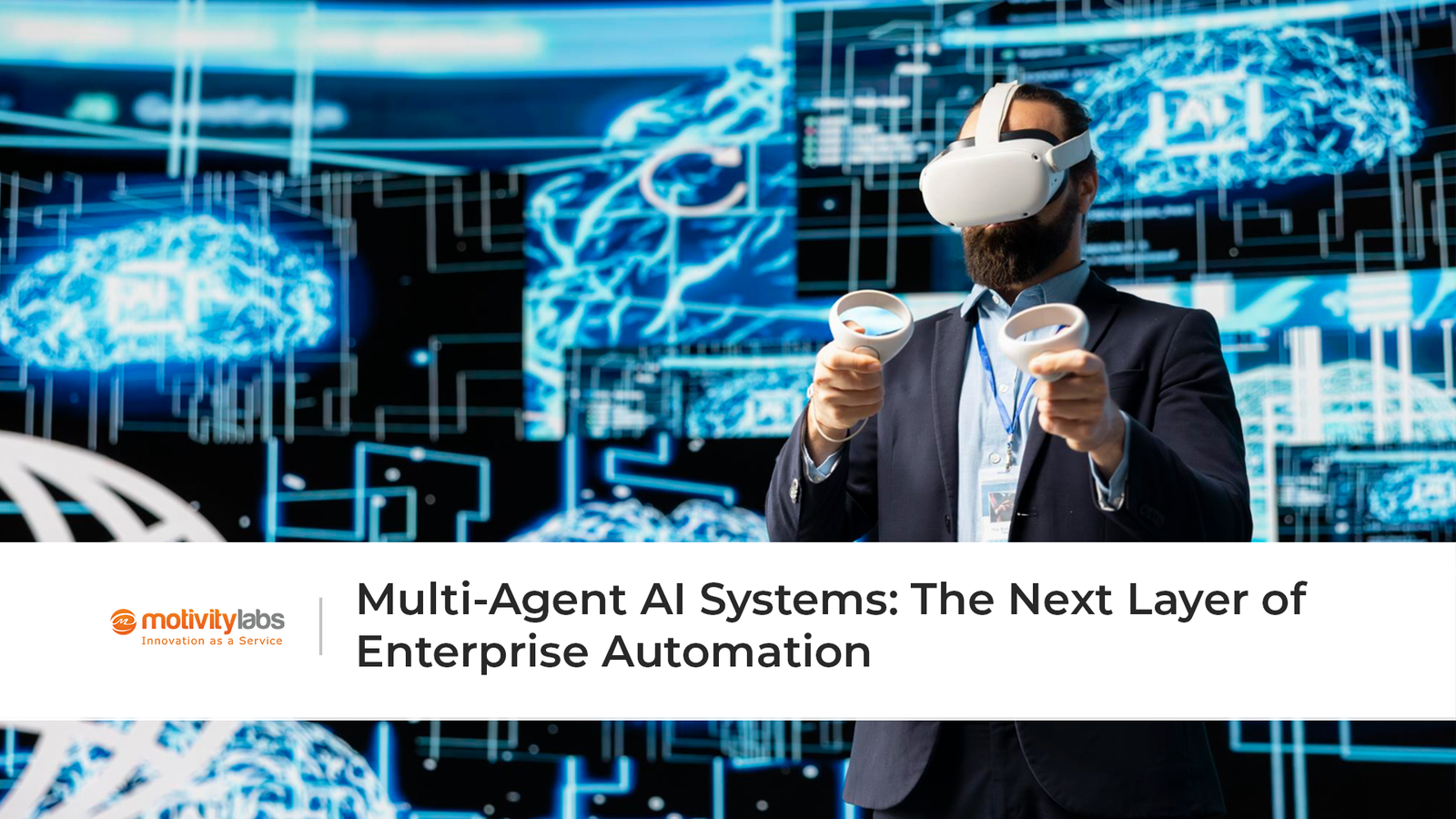
Multi-Agent AI Systems: The Next Layer of Enterprise Automation
For years, enterprise automation has been about efficiency, streamlining workflows, reducing manual effort, and improving speed. But what happens when
Are enterprises ready for AI that doesn’t just assist but acts?
For years, enterprise automation has been about efficiency, streamlining workflows, reducing manual effort, and improving speed. But what happens when automation evolves from executing tasks to making decisions, coordinating actions, and learning continuously?
That’s where multi-agent AI systems come in.
The shift is already underway. In fact, 79% of organizations report adopting AI agents in some capacity, signaling a rapid move toward autonomous systems in enterprise environments . And this is just the beginning.
What Are Multi-Agent AI Systems?
At a fundamental level, multi-agent AI systems (MAS) consist of multiple intelligent agents working together to achieve shared goals.
Unlike traditional automation:
- A single system handles predefined tasks
- Logic is static and rule-based
Multi-agent systems operate differently:
- Multiple AI agents collaborate, specialize, and communicate
- Tasks are distributed dynamically
- Decisions are made in real time
These agents can cooperate, compete, or coordinate, depending on the objective, making them ideal for complex, dynamic enterprise environments.
Why Enterprises Are Moving Beyond Single-Agent AI
Single AI models are powerful, but limited.
They can:
- Analyze
- Predict
- Respond
But they struggle with:
- Multi-step workflows
- Cross-system coordination
- Context switching
Multi-agent systems solve this by breaking down complexity into smaller, specialized tasks and orchestrating them seamlessly.
According to industry insights, multi-agent architectures can deliver 40–60% efficiency gains in enterprise processes, highlighting their impact on scalability and productivity.
The Core Advantage: From Automation to Orchestration
Traditional automation focuses on task execution.
Multi-agent systems focus on workflow orchestration.
Here’s the difference:
| Traditional Automation | Multi-Agent AI Systems |
|---|---|
| Rule-based tasks | Autonomous decision-making |
| Isolated workflows | Cross-system coordination |
| Static processes | Adaptive, learning systems |
| Limited scalability | Exponential scalability |
Multi-agent systems enable enterprises to move from:
Automating tasks → Automating decisions
This is the real leap.
How Multi-Agent AI Powers Enterprise Automation
1. End-to-End Workflow Automation
Multi-agent systems can handle entire workflows:
- Data ingestion
- Analysis
- Decision-making
- Execution
Each agent specializes in a specific role, creating a collaborative automation ecosystem.
2. Real-Time Decision Intelligence
Unlike traditional systems that rely on batch processing, multi-agent systems:
- Process data in real time
- Adapt to changing conditions
- Trigger immediate actions
This enables faster, smarter decision-making across business functions.
3. Cross-System Integration
One of the biggest challenges in enterprises is siloed systems.
Multi-agent systems:
- Interact across platforms (ERP, CRM, IoT)
- Pull and process data seamlessly
- Execute actions across systems
This creates a unified operational layer across the enterprise
4. Continuous Learning and Optimization
Agents learn from outcomes and improve over time.
This means:
- Better predictions
- Smarter decisions
- Continuous optimization
Automation is no longer static, it becomes adaptive.
Key Use Cases Across Industries
1. Customer Experience Automation
Agents handle:
- Queries
- Recommendations
- Personalization
Result: Faster, more intelligent interactions at scale.
2. Supply Chain Optimization
Agents coordinate:
- Demand forecasting
- Inventory management
- Logistics
Result: Reduced delays, improved efficiency.
3. Financial Operations
Agents automate:
- Risk analysis
- Fraud detection
- Compliance monitoring
Result: Higher accuracy, reduced manual effort.
4. IT and DevOps Automation
Agents manage:
- Incident detection
- Root cause analysis
- Automated resolution
Result: Faster system recovery and reduced downtime.
The Role of Multi-Agent Systems in Digital Innovation
As enterprises push toward digital innovation, the need for intelligent, autonomous systems becomes critical.
Multi-agent AI enables:
- Faster innovation cycles
- Smarter product development
- Scalable operations
It acts as the intelligence layer that connects data, systems, and decisions.
Challenges in Scaling Multi-Agent AI
Despite the promise, adoption comes with challenges:
1. Coordination Complexity: Managing communication between multiple agents can be difficult.
2. Data Dependency: Agents require high-quality, unified data to function effectively.
3. Governance and Trust: Ensuring transparency and accountability in decision-making is critical.
4. Integration Barriers: Legacy systems may limit seamless implementation.
However, these challenges are being addressed through better orchestration frameworks and enterprise AI architectures.
How Motivity Labs Is Reinforcing This Shift
As enterprises move toward multi-agent architectures, the real challenge is not just building AI, but making it work at scale.
This is where Motivity Labs plays a critical role.
Motivity Labs enables organizations to:
- Design and deploy multi-agent AI ecosystems tailored to enterprise workflows
- Integrate data across systems for unified intelligence
- Build conversational and decision-driven interfaces
- Ensure scalability, security, and compliance
By combining data engineering, AI orchestration, and real-time analytics, Motivity Labs helps enterprises transition from fragmented automation to intelligent, connected systems.
The focus is not just on implementing AI, but on making AI actionable and impactful.
The Future of Enterprise Automation: What Lies Ahead
The evolution of multi-agent AI is just beginning.
Key trends shaping the future include:
1. Autonomous Enterprises: Organizations will operate with minimal human intervention, driven by AI systems that manage workflows end-to-end.
2. Hyper-Specialized Agents: Agents will become more domain-specific, improving accuracy and efficiency.
3. Agent-to-Agent Collaboration: Systems will evolve to enable seamless communication between agents across organizations.
4. Real-Time Decision Ecosystems
Enterprises will move toward systems that:
- Monitor
- Analyze
- Decide
- Act
all in real time.
5. Widespread Adoption Across Software: By 2028, 33% of enterprise software applications are expected to include agentic AI, marking a major shift toward autonomous systems .
Conclusion
Multi-agent AI systems are not just an upgrade to automation-they represent a fundamental shift in how enterprises operate.
They move organizations from:
Automation → Intelligence
Execution → Orchestration
Data → Decisions
As complexity grows, the ability to coordinate systems, data, and decisions will define competitive advantage.
And in that future, enterprises won’t just run processes.
They will run intelligent ecosystems powered by AI agents.
Future Outlook
The next phase of enterprise automation will not be about adding more AI,it will be about connecting AI systems intelligently.
Multi-agent architectures will become the backbone of enterprise operations, enabling organizations to:
- Scale faster
- Innovate smarter
- Operate autonomously
The question is no longer if enterprises will adopt multi-agent AI.
It’s how fast they can adapt to it.
Working through the same problem?
We'll map your situation with you in 30 minutes — no pitch deck.
Let's Connect