Artificial Intelligence has moved far beyond being a futuristic concept. Over the last two years, enterprises worldwide have aggressively experimented with Generative AI, Large Language Models (LLMs), copilots, and intelligent automation platforms. Today, the conversation has shifted once again, this time toward Agentic AI.
From boardrooms to technology conferences, Agentic AI is being positioned as the next major leap in enterprise transformation. Unlike traditional AI systems that generate responses based on prompts, Agentic AI systems are designed to make decisions, execute tasks, interact with multiple systems, and operate with varying levels of autonomy. In simple terms, these AI agents are evolving from assistants into digital workers.
The excitement is understandable. Organizations envision AI agents managing customer support workflows, coordinating supply chains, automating software development, handling compliance checks, generating reports, and even making operational decisions with minimal human intervention.
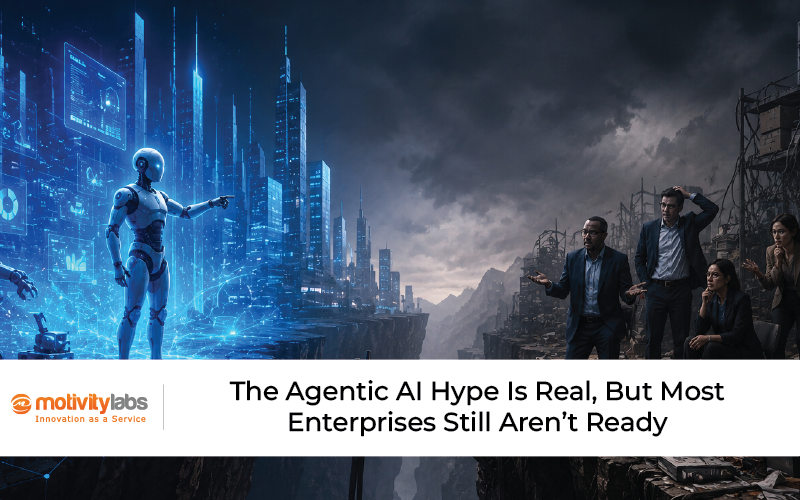
However, beneath the excitement lies a reality that many enterprises are beginning to discover: while the hype around Agentic AI is real, enterprise readiness remains significantly behind.
The gap between AI ambition and AI execution has become one of the defining challenges of the current technology landscape.
The Rise of Agentic AI
Agentic AI represents a shift from passive intelligence to active execution.
Traditional Generative AI models typically respond when asked. Agentic systems, on the other hand, can pursue objectives, break tasks into smaller actions, interact with tools, retrieve information, make decisions, and continuously adapt their behavior to achieve outcomes.
This evolution is attracting substantial investment. According to Deloitte, nearly 80% of automation leaders are expected to accelerate investments in AI agents, while one-third of enterprise software applications are projected to include agentic capabilities by 2028. Deloitte also predicts that 25% of organizations currently using Generative AI will launch Agentic AI pilots, increasing to 50% by 2027. These numbers highlight the growing confidence enterprises have in autonomous AI systems.
The business case appears compelling. Organizations see opportunities to improve productivity, reduce operational costs, accelerate decision-making, and create entirely new business models powered by intelligent automation.
Yet enthusiasm alone does not guarantee successful implementation.
The Enterprise Readiness Gap
While organizations are eager to deploy AI agents, most are still struggling with the foundational requirements necessary for success.
Recent findings from McKinsey suggest that while AI adoption continues to grow rapidly, the transition from experimental pilots to enterprise-wide value creation remains a work in progress for most organizations. Many companies have successfully demonstrated AI capabilities in controlled environments but face significant challenges when attempting to scale them across business functions.
This is where the readiness gap emerges.
Many enterprises are attempting to deploy highly autonomous AI systems while operating on fragmented data ecosystems, outdated infrastructure, inconsistent governance frameworks, and unclear operational ownership structures.
In other words, organizations are trying to build autonomous intelligence on top of operational foundations that were never designed for autonomy.
The result is predictable: promising pilots that fail to scale.
Why Data Remains the Biggest Obstacle
Every successful AI initiative ultimately depends on data quality.
Despite the growing sophistication of AI models, poor data continues to undermine enterprise outcomes. IBM reports that concerns around data accuracy, bias, insufficient proprietary data, and lack of AI expertise remain among the top barriers to AI adoption. Nearly 45% of organizations identify data accuracy and bias as a major challenge, while 42% struggle with insufficient proprietary data required to customize AI systems effectively.
For Agentic AI, the challenge becomes even more critical.
An autonomous agent making decisions based on incomplete, outdated, or inaccurate information can create operational risks at scale. Unlike a chatbot generating an incorrect response, an AI agent may trigger actions, initiate workflows, or influence business processes based on flawed assumptions.
Gartner further predicts that organizations will abandon a significant percentage of AI projects that lack AI-ready data foundations. Data readiness is no longer a technical requirement, it has become a strategic necessity.
Before enterprises ask whether AI agents can automate operations, they must first determine whether their data ecosystems are prepared to support autonomous decision-making.
Governance Is Becoming More Important Than Innovation
One of the most overlooked aspects of Agentic AI adoption is governance.
Most enterprise discussions still focus on model performance, automation capabilities, and productivity gains. However, governance is increasingly becoming the factor that determines whether AI deployments succeed or fail.
A recent Gartner analysis highlighted that nearly 40% of organizations may decommission or significantly restrict AI agents due to governance failures. The report emphasizes that organizations often apply uniform governance models to agents with vastly different levels of autonomy, creating either excessive restrictions or dangerous operational freedom.
This challenge becomes even more complex in regulated industries such as healthcare, banking, insurance, manufacturing, and public sector operations.
Questions around accountability, auditability, compliance, explainability, cybersecurity, and risk management become significantly harder when AI systems begin making decisions independently.
The future winners in Agentic AI will not necessarily be those with the most advanced models. They will be the organizations capable of balancing innovation with governance.
The ROI Problem Nobody Wants to Discuss
Another growing challenge is the economics of Agentic AI.
For much of the AI boom, discussions centered on possibilities rather than profitability. However, enterprises are increasingly asking a more practical question: where is the return on investment?
Recent reports indicate growing concerns among technology leaders regarding escalating AI costs. Organizations including Microsoft, Uber, Meta, and Amazon have reportedly begun scrutinizing the economics of large-scale AI deployments as usage costs continue to rise. Industry observers have pointed to a phenomenon known as “tokenmaxxing,” where increased AI utilization drives operational expenses faster than measurable productivity gains.
Agentic AI amplifies this challenge.
Unlike traditional AI interactions, AI agents often perform multi-step reasoning, execute multiple actions, access external systems, and continuously monitor workflows. This can dramatically increase computational costs.
Without clear performance metrics and business outcomes, organizations risk creating expensive automation ecosystems that generate impressive demonstrations but limited enterprise value.
The future of Agentic AI will be determined not by how autonomous an agent becomes, but by how effectively it contributes measurable business outcomes.
Why Human-in-the-Loop Still Matters
Despite narratives around fully autonomous enterprises, most successful AI deployments continue to rely on human oversight.
A recent industry study examining Agentic AI adoption found that many organizations face what researchers describe as a “verification gap.” While AI agents demonstrate impressive capabilities in controlled environments, enterprises still lack reliable mechanisms to verify outputs consistently in production environments. As a result, human supervision remains essential.
This highlights a critical misconception surrounding Agentic AI.
The goal is not necessarily to replace human expertise. The goal is to augment human decision-making, accelerate workflows, and enable employees to focus on higher-value activities.
Why Human-in-the-Loop Still Matters
Despite narratives around fully autonomous enterprises, most successful AI deployments continue to rely on human oversight.
A recent industry study examining Agentic AI adoption found that many organizations face what researchers describe as a “verification gap.” While AI agents demonstrate impressive capabilities in controlled environments, enterprises still lack reliable mechanisms to verify outputs consistently in production environments. As a result, human supervision remains essential.
This highlights a critical misconception surrounding Agentic AI.
The goal is not necessarily to replace human expertise. The goal is to augment human decision-making, accelerate workflows, and enable employees to focus on higher-value activities.
The most successful enterprise AI strategies will likely be hybrid models where humans and AI agents collaborate rather than compete.
Organizations that view AI as a workforce multiplier rather than a workforce replacement strategy are likely to realize greater long-term value.
Building an Enterprise That Is Actually Ready for Agentic AI
Readiness for Agentic AI is not determined by how many AI tools an organization purchases.
It is determined by the maturity of its digital foundation.
Organizations seeking sustainable success must focus on several key areas: establishing AI-ready data architectures, implementing governance frameworks, modernizing enterprise applications, creating secure integration environments, defining ownership models, and developing workforce readiness programs.
This is where technology partners play a crucial role.
At Motivity Labs, we believe that Agentic AI adoption should not begin with the agent itself. It should begin with enterprise readiness.
Building scalable AI ecosystems requires more than deploying models. It requires connecting data, cloud infrastructure, enterprise applications, security frameworks, automation systems, and business workflows into a cohesive architecture capable of supporting autonomous intelligence.
Our approach focuses on helping enterprises bridge the gap between experimentation and execution by building AI-ready digital foundations that can support responsible, scalable, and measurable Agentic AI adoption.
The organizations that succeed in the coming years will not be those that deploy AI agents the fastest. They will be those that create the operational, technological, and governance frameworks necessary to scale them effectively.
Conclusion
The Agentic AI revolution is undoubtedly real.
The technology is advancing rapidly, investment is accelerating, and enterprises are actively exploring how autonomous AI systems can transform operations, customer experiences, and business models.
Yet the reality is that most organizations remain in the early stages of readiness.
Challenges around data quality, governance, infrastructure, security, workforce adaptation, and ROI measurement continue to slow enterprise-scale adoption. The gap between what AI agents can theoretically achieve and what enterprises can practically deploy remains substantial.
Agentic AI is not simply another software upgrade. It represents a fundamental shift in how work is performed, decisions are made, and organizations operate.
The enterprises that recognize this distinction and invest in readiness before rushing toward autonomy will be best positioned to unlock the true value of Agentic AI.
In the race toward autonomous enterprises, readiness may ultimately become the biggest competitive advantage of all.