Cracking LLM Fine-Tuning: From Generic Models to Business Intelligence
Artificial Intelligence has rapidly evolved from rule-based automation to intelligent systems capable of understanding language, generating content, analyzing
Artificial Intelligence has rapidly evolved from rule-based automation to intelligent systems capable of understanding language, generating content, analyzing documents, and assisting in business decision-making. At the center of this transformation are Large Language Models (LLMs) such as GPT, Llama, Claude, and Mistral. These foundational models are trained on vast internet-scale datasets, making them incredibly powerful for general-purpose tasks. However, when enterprises attempt to apply these generic models to specialized business workflows, a major challenge emerges: general intelligence does not automatically translate into business intelligence.
This is where LLM fine-tuning becomes critical.
Organizations today require AI systems that understand industry terminology, internal processes, customer behavior, compliance requirements, and domain-specific workflows. A generic model may generate fluent responses, but without contextual alignment, it can still produce inaccurate, irrelevant, or hallucinated outputs. Fine-tuning bridges this gap by adapting foundational AI models to enterprise-specific needs.
As businesses increasingly adopt AI-powered automation, LLM fine-tuning is becoming a strategic differentiator for enterprises aiming to build accurate, secure, scalable, and production-ready AI systems.
What is LLM Fine-Tuning?
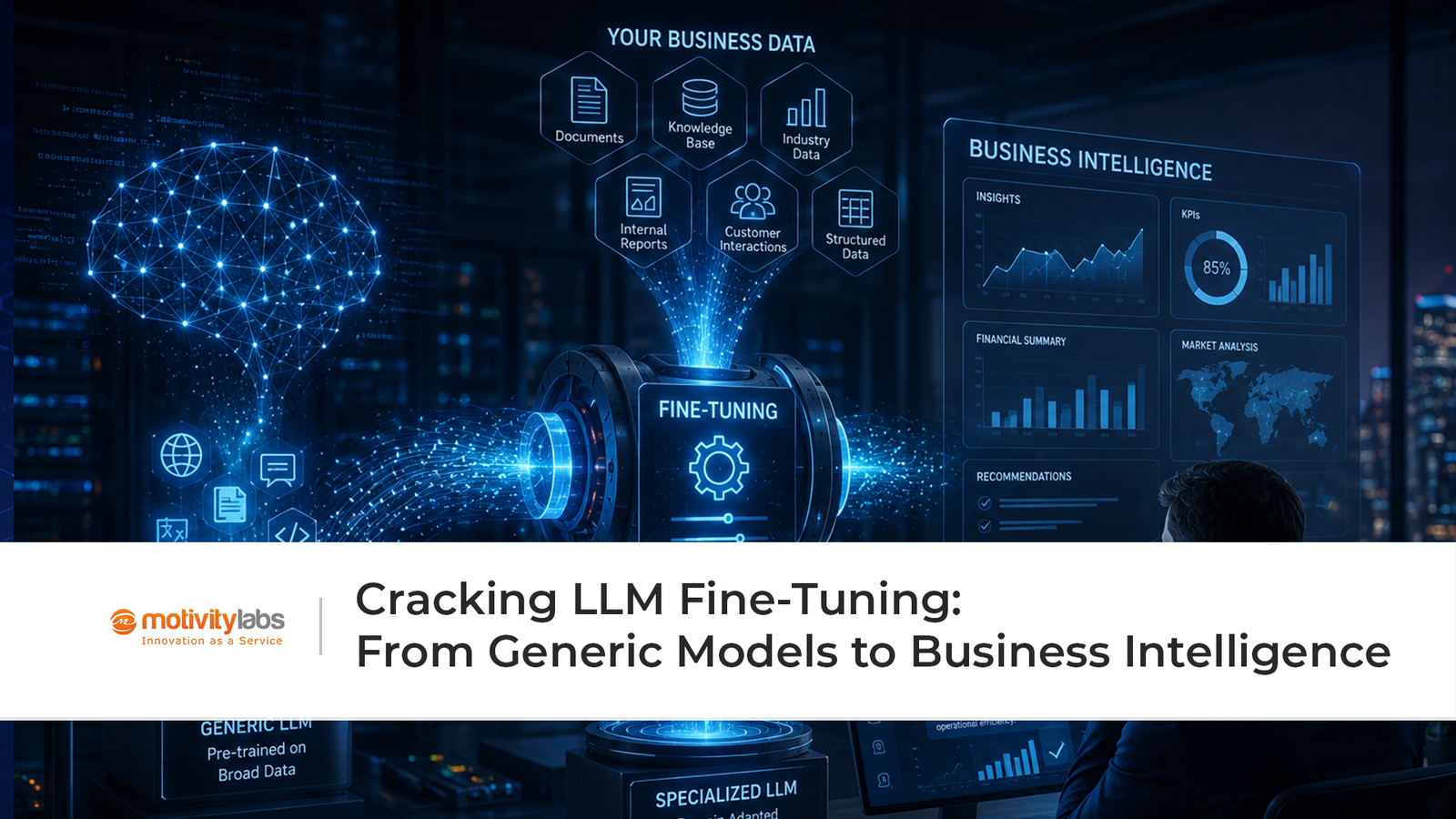
LLM fine-tuning is the process of taking a pre-trained large language model and training it further on a specialized dataset to improve its performance for a specific domain, task, or business use case.
Foundational models are trained on broad public datasets that include books, websites, articles, and open repositories. While this gives them strong general reasoning abilities, they often lack industry-specific expertise. Fine-tuning allows enterprises to customize these models using proprietary business data such as internal documentation, customer interactions, product manuals, legal frameworks, healthcare records, financial reports, or technical knowledge bases.
Instead of building an AI model from scratch, enterprises leverage existing pre-trained models and adapt them for business intelligence applications. This significantly reduces development costs, computational overhead, and deployment timelines.
For example, a healthcare organization can fine-tune an LLM on medical records and clinical terminology to improve diagnostic support systems. Similarly, a financial institution can train a model on compliance documents and market reports to build intelligent risk analysis tools.
The result is an AI system that delivers more relevant, accurate, and context-aware responses aligned with business objectives.
Why Generic AI Models Fall Short in Enterprises
Generic LLMs are highly capable conversational systems, but enterprises operate in environments where precision, governance, and contextual understanding are essential.
A standard model may not fully understand domain-specific terminology, regulatory requirements, or organization-specific workflows. In sectors such as banking, healthcare, insurance, manufacturing, and cybersecurity, even small inaccuracies can lead to operational risks or compliance failures.
Another challenge is data freshness and proprietary knowledge. Most public LLMs are trained on static datasets with knowledge cut-off limitations. They may not understand recent policies, updated regulations, internal product specifications, or organizational procedures.
Businesses also face concerns around hallucinations, data privacy, and output consistency. Enterprise AI systems must generate trustworthy outputs while complying with governance and security requirements.
Fine-tuning addresses these limitations by embedding domain expertise directly into the model’s behavior. It helps AI systems generate outputs that are more aligned with organizational expectations, operational logic, and industry standards.
How LLM Fine-Tuning Works
The LLM fine-tuning process generally begins with selecting a foundational model such as Llama, Mistral, GPT-based architectures, or other open-source transformer models.
The next step involves preparing a high-quality dataset relevant to the target business application. Data quality is one of the most important factors influencing fine-tuning success. Enterprises typically curate structured and unstructured datasets including customer service conversations, operational workflows, internal manuals, contracts, product documents, FAQs, and domain-specific knowledge repositories.
Once the data is cleaned and formatted, the model undergoes additional training where its parameters are adjusted to better understand the target domain. Depending on business objectives and computational resources, organizations may choose different fine-tuning approaches including full fine-tuning, parameter-efficient fine-tuning (PEFT), or Low-Rank Adaptation (LoRA).
Modern enterprise AI strategies increasingly favor parameter-efficient approaches because they reduce training costs while maintaining high performance.
After training, the model is evaluated for accuracy, relevance, hallucination control, security, and task performance before deployment into production systems.
The Business Impact of Fine-Tuned LLMs
The adoption of LLM fine-tuning is reshaping enterprise AI strategies across industries.
One of the biggest advantages is improved accuracy. Fine-tuned models produce outputs that are far more aligned with business contexts compared to generic systems. This improves decision-making, customer experience, and operational efficiency.
Another significant benefit is automation at scale. Enterprises can deploy fine-tuned AI systems for customer support, fraud detection, document analysis, contract review, intelligent search, compliance automation, predictive maintenance, and workflow optimization.
Fine-tuned models also help organizations maintain brand consistency. AI-generated responses can be aligned with company tone, terminology, and communication standards.
Security and governance are equally important advantages. Organizations can train models on private enterprise data while implementing controlled access and compliance measures. This is especially important for industries handling sensitive customer information.
According to enterprise AI research, businesses increasingly combine fine-tuning with Retrieval-Augmented Generation (RAG) frameworks to create more reliable and scalable AI systems. Fine-tuning improves task specialization, while RAG enables access to real-time and dynamic information sources.
Fine-Tuning vs RAG: Understanding the Difference
A common discussion in enterprise AI revolves around choosing between LLM fine-tuning and Retrieval-Augmented Generation (RAG). While both approaches improve AI performance, they solve different problems.
Fine-tuning modifies the model itself by embedding specialized knowledge into its parameters. It is ideal for scenarios requiring domain expertise, structured outputs, workflow alignment, and task-specific intelligence.
RAG, on the other hand, retrieves external information in real time and feeds it into the model during inference. This is useful when information changes frequently, such as policies, financial data, or product updates.
Many enterprises now adopt hybrid architectures that combine both approaches. Fine-tuned models provide domain understanding, while RAG ensures information remains current and verifiable. This hybrid strategy significantly improves enterprise AI reliability and reduces hallucination risks.
Challenges in LLM Fine-Tuning
Despite its advantages, LLM fine-tuning comes with technical and operational challenges.
One major challenge is computational cost. Training large models requires high-performance GPUs, optimized infrastructure, and significant energy consumption. Organizations must carefully evaluate infrastructure investments and scalability requirements.
Data preparation is another critical hurdle. Fine-tuning depends heavily on clean, structured, and high-quality datasets. Poorly curated data can lead to inaccurate outputs, model bias, or overfitting.
Overfitting remains a concern when models become too specialized and lose their ability to generalize across broader scenarios. Enterprises must balance specialization with adaptability.
Model governance and security also require attention. Organizations need frameworks for monitoring AI outputs, ensuring compliance, and preventing data leakage.
Finally, continuous maintenance is essential. As business processes evolve, fine-tuned models require updates and retraining to remain relevant and accurate.
The Future of Enterprise AI with Fine-Tuned LLMs
The future of enterprise AI will not rely solely on massive generic models. Instead, businesses are moving toward domain-specialized AI ecosystems tailored to specific operational goals.
Industry-specific AI copilots, autonomous workflow assistants, intelligent surveillance systems, AI-driven analytics platforms, and multilingual enterprise assistants are rapidly becoming mainstream.
Fine-tuning is also becoming more efficient with advances in parameter-efficient training methods, quantization techniques, and smaller specialized language models. This is making enterprise AI more accessible even for mid-sized organizations.
As AI regulations evolve globally, enterprises will increasingly prioritize explainability, transparency, and governance. Fine-tuned AI systems integrated with enterprise-grade security and monitoring frameworks will play a central role in this transformation.
The shift is no longer about simply deploying AI. It is about deploying AI that understands business context, adapts to organizational workflows, and generates measurable operational value.
Motivity Labs’ Role in Enterprise AI Transformation
As enterprises accelerate their AI adoption journey, technology partners with expertise in AI engineering, cloud transformation, and enterprise integration are becoming increasingly important.
Motivity Labs plays a significant role in helping organizations build scalable AI ecosystems tailored to real-world business environments. Through its expertise in AI-driven digital transformation, cloud-native architectures, analytics, and enterprise application modernization, Motivity Labs enables businesses to operationalize advanced AI solutions efficiently.
The company supports enterprises in designing intelligent AI frameworks that combine LLM fine-tuning, data engineering, automation, analytics, and scalable deployment pipelines. By integrating AI with enterprise systems, Motivity Labs helps organizations improve operational efficiency, customer engagement, predictive intelligence, and decision-making capabilities.
With businesses increasingly demanding secure and domain-specific AI implementations, organizations like Motivity Labs are positioned to bridge the gap between foundational AI technologies and enterprise-grade execution.
Conclusion
The rise of generative AI has opened enormous possibilities for businesses, but generic AI models alone cannot address enterprise complexity. Organizations require AI systems that understand their industry, workflows, regulations, customers, and operational goals.
LLM fine-tuning enables this transformation by converting generalized language models into domain-aware business intelligence systems. From improving accuracy and automation to enhancing governance and personalization, fine-tuned models are redefining enterprise AI capabilities.
As enterprises continue adopting AI at scale, the future will belong to organizations that can successfully combine fine-tuning, retrieval systems, governance frameworks, and scalable infrastructure into unified AI ecosystems.
Businesses are no longer asking whether to adopt AI. The real question is how intelligently they can adapt AI to their unique business environment, and LLM fine-tuning is becoming the foundation of that answer.
Working through the same problem?
We'll map your situation with you in 30 minutes — no pitch deck.
Let's Connect