AI Is Not Just a Chatbot: 5 Real-World Applications Transforming Industries
When people hear the term Artificial Intelligence (AI), they often think of chatbots and virtual assistants that can answer questions or hold conversations.
When people hear the term Artificial Intelligence (AI), they often think of chatbots and virtual assistants that can answer questions or hold conversations. However, AI has evolved far beyond these applications and now plays a crucial role in transforming industries worldwide. From helping doctors diagnose diseases and enabling banks to detect fraudulent transactions to optimizing manufacturing processes and improving customer experiences in retail, AI is becoming an essential part of everyday business operations. Organizations are leveraging AI to automate tasks, analyze vast amounts of data, make smarter decisions, and increase efficiency across various functions. As AI technology continues to advance, its impact extends far beyond simple conversations, creating innovative solutions to real-world challenges. In this blog, we will explore five real-world applications of AI that demonstrate how it is revolutionizing industries and reshaping the way businesses operate.
What Is Artificial Intelligence Beyond Chatbots?
Artificial Intelligence (AI) is much more than chatbots and virtual assistants designed to interact with users through conversations. While conversational AI focuses on understanding and responding to human language, modern AI encompasses a broader range of technologies, including machine learning, computer vision, predictive analytics, and intelligent automation. These technologies enable systems to learn from data, recognize patterns, forecast outcomes, and perform complex tasks with minimal human intervention. Businesses are increasingly investing in AI because it helps improve operational efficiency, supports data-driven decision-making, enhances customer experiences through personalization, reduces costs, and provides the scalability needed to remain competitive in rapidly evolving markets.
Real-World AI Applications
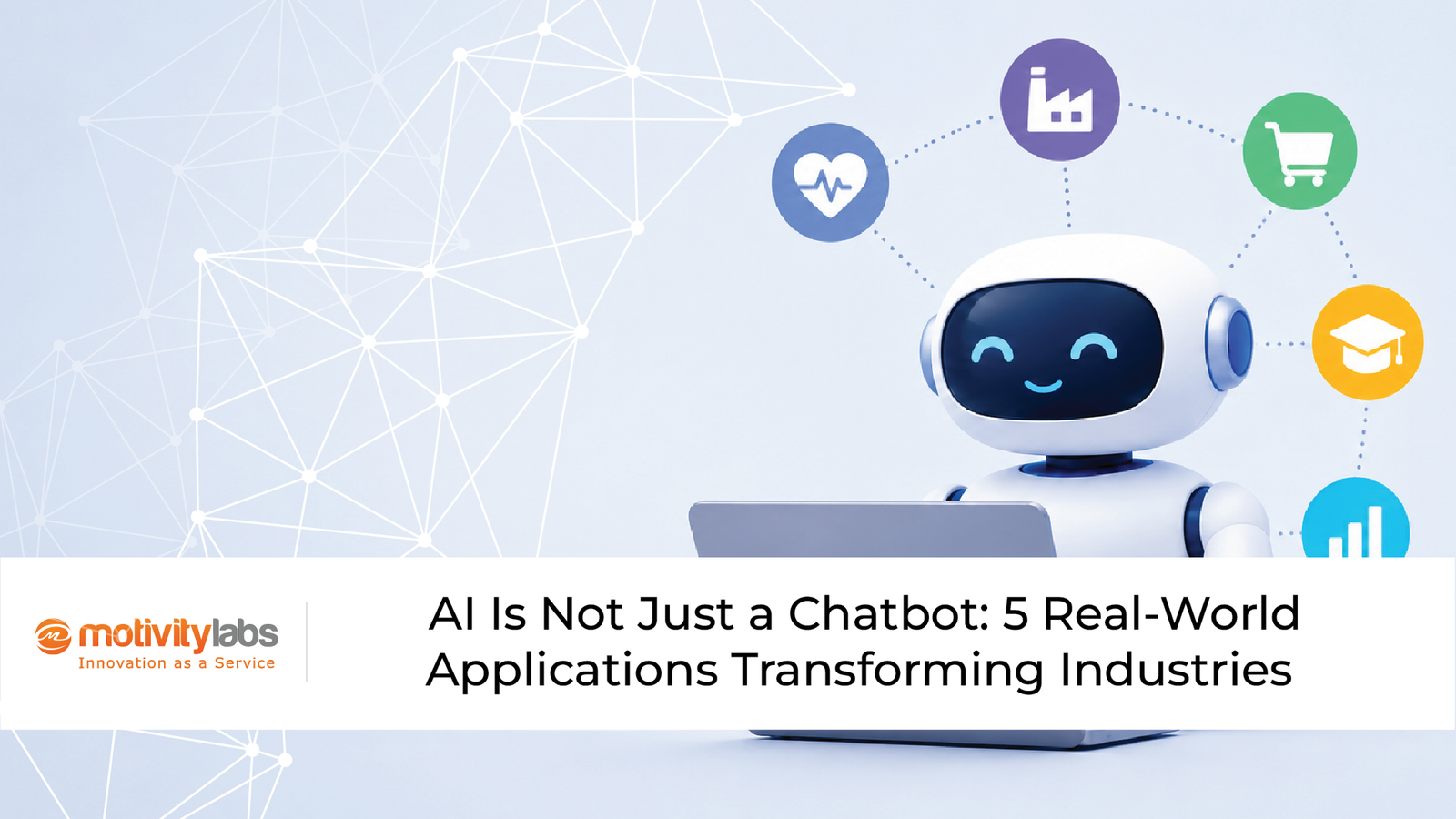
In this section, we will discover how AI is transforming healthcare, finance, OCR automation, retail, and transportation.
Healthcare Diagnosis and Patient Care
Artificial Intelligence is transforming healthcare by improving the speed and accuracy of medical diagnoses and treatment planning.Artificial Intelligence is transforming healthcare by improving the speed and accuracy of medical diagnoses and treatment planning. AI-powered medical imaging systems can analyze X-rays, MRIs, and CT scans to identify abnormalities and detect diseases at an early stage. Additionally, AI helps create personalized treatment plans by analyzing patient histories, medical records, and health data to recommend tailored healthcare solutions. These capabilities enable healthcare providers to deliver better patient outcomes while improving operational efficiency. Key Benefits:
- Improved diagnostic accuracy
- Early disease detection
- Faster treatment recommendations
- Reduced workload for medical professionals
- Better patient outcomes
Fraud Detection in Finance
The financial sector uses AI to strengthen security and minimize fraud risks. AI systems monitor transactions in real time, instantly identifying suspicious activity and unusual spending patterns that may indicate fraud. Financial institutions also leverage AI for risk assessment and credit scoring by analyzing customer data and financial behavior, thereby enabling more accurate lending and investment decisions. Key Benefits:
- Enhanced financial security
- Faster fraud detection
- Reduced financial losses
- More accurate credit assessments
- Improved decision-making processes
Document Processing and OCR Automation
AI-powered OCR technology enables businesses to convert printed, handwritten, and scanned documents into editable digital text. Organizations use OCR to automate invoice processing, extract data from forms, digitize records, and reduce manual data entry. With tools like OCRonline, businesses can process large volumes of documents more efficiently while minimizing human errors. Combined with AI, OCR can accurately recognize text, organize information, and streamline workflows across industries such as healthcare, finance, education, and logistics. Key Benefits:
- Faster document processing
- Reduced manual data entry
- Improved accuracy
- Better record management
- Increased operational efficiency
AI in Retail and E-Commerce
AI is helping retailers deliver personalized shopping experiences and improve inventory management. Through advanced data analysis, AI can understand customer preferences and provide tailored product recommendations that increase engagement and sales. It also forecasts demand trends and purchasing patterns, enabling businesses to maintain optimal inventory levels and avoid overstocking or stock shortages. Key Benefits:
- Better customer experiences
- Personalized shopping recommendations
- Improved inventory management
- Increased sales and conversions
- Higher revenue generation
Smart Transportation and Logistics
The transportation and logistics industry relies on AI to improve efficiency, reduce costs, and enhance safety. AI-powered route optimization tools analyze traffic conditions, weather patterns, and delivery schedules to identify the most efficient routes. Additionally, autonomous and assisted driving technologies use AI to improve vehicle performance, reduce human error, and support safer transportation systems. Key Benefits:
- Faster deliveries
- Reduced fuel consumption
- Lower operational costs
- Enhanced transportation safety
- Improved logistics efficiency
Challenges of AI Adoption
Here are some challenges of AI Adoption.
Data Privacy and Security Concerns
One of the biggest challenges of AI adoption is protecting sensitive data. AI systems often rely on large amounts of information to learn and make decisions. This data may include customer details, financial records, or business information. If not managed properly, organizations can face security breaches and privacy violations. Businesses must implement strong security measures to prevent unauthorized access. Data encryption, secure storage, and regular monitoring are essential. Companies must also comply with privacy regulations and industry standards. Building trust through responsible data handling is critical for successful AI adoption and long-term business growth.
Implementing AI solutions can require a significant initial investment. Businesses may need to purchase new software, upgrade infrastructure, and invest in data management systems. Additional costs can include employee training, system integration, and ongoing maintenance. Small and medium-sized businesses may find these expenses challenging at the beginning. However, successful AI implementation can provide long-term value through increased efficiency and reduced operational costs. Organizations should carefully assess their goals and budget before adopting AI technologies. A clear strategy helps maximize return on investment and ensures that AI initiatives deliver measurable business benefits.
As AI becomes more powerful, ethical and regulatory concerns continue to grow. AI systems must operate fairly and avoid biased decision-making. Organizations should ensure transparency in how AI models collect, process, and use data. Users should understand when they are interacting with AI-driven systems. Governments and regulatory bodies are also introducing guidelines to promote responsible AI development. Businesses must stay informed about evolving regulations and compliance requirements. Ethical AI practices help build customer trust and protect brand reputation. Responsible use of AI is essential for creating sustainable and beneficial technology solutions.
Conclusion
Artificial Intelligence is no longer limited to chatbots and virtual assistants. It is transforming industries by improving healthcare diagnostics, strengthening financial security, automating document processing through OCR, enhancing retail experiences, and optimizing transportation and logistics operations. These applications demonstrate how AI can increase efficiency, improve decision-making, and drive innovation across various sectors. While challenges such as data privacy, implementation costs, and ethical concerns remain, the benefits of AI continue to outweigh the obstacles for many organizations. As technology advances, AI will play an even greater role in shaping the future of businesses and everyday life.
Working through the same problem?
We'll map your situation with you in 30 minutes — no pitch deck.
Let's Connect