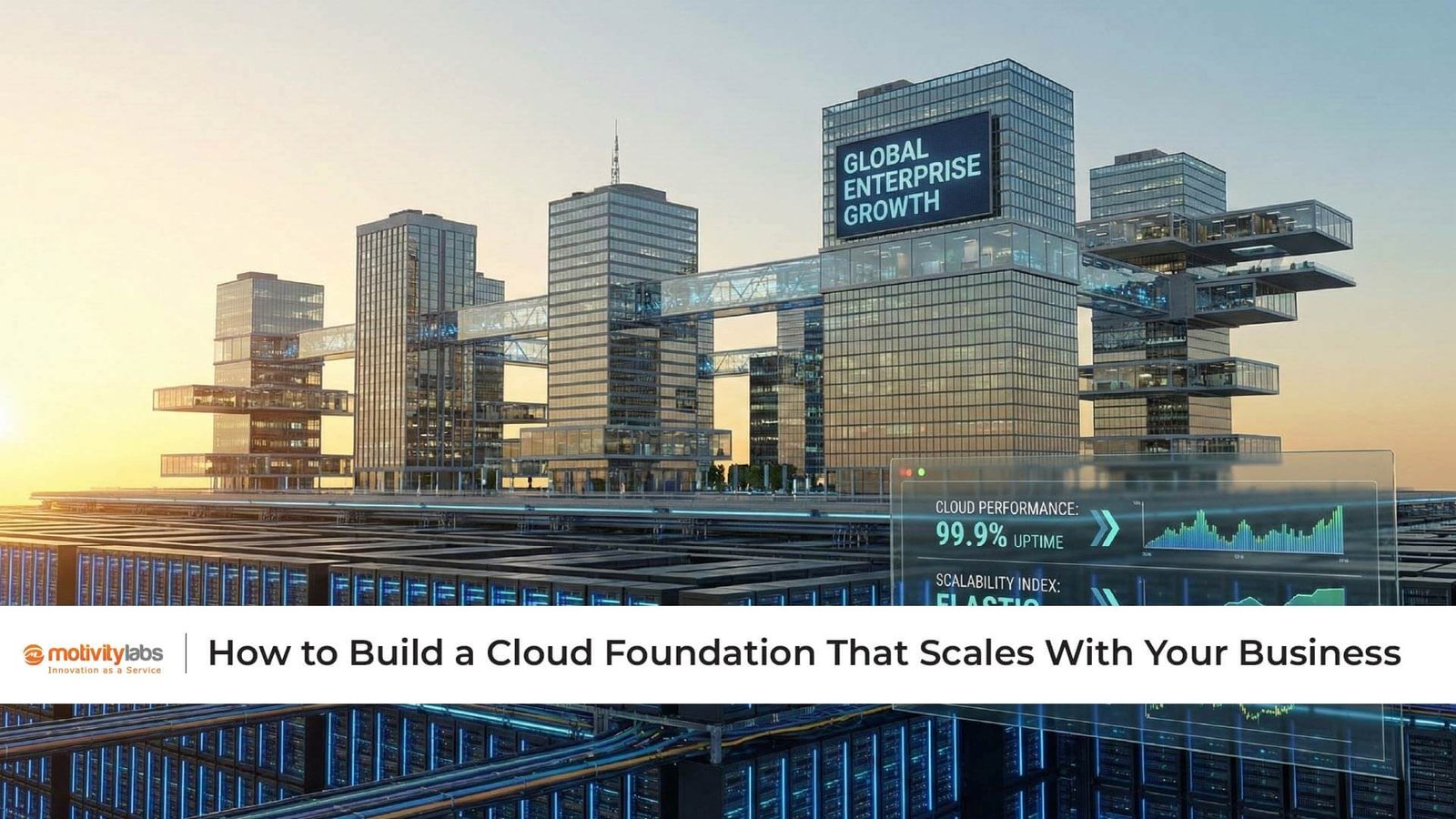
How to Build a Cloud Foundation That Scales With Your Business
Most organizations move to the cloud to solve today’s problems-faster deployments, lower infrastructure costs, or improved operational efficiency. But few
Is your cloud ready for the business you’ll become tomorrow?
Most organizations move to the cloud to solve today’s problems-faster deployments, lower infrastructure costs, or improved operational efficiency. But few stop to ask a critical question: will their cloud infrastructure still perform when the business doubles in size, expands globally, or integrates AI-driven systems?
The cloud isn’t just a destination. It’s a foundation. And like any foundation, its strength determines how far and how fast you can grow.
A well-designed cloud foundation enables scalability, flexibility, and innovation. A weak one creates bottlenecks, rising costs, and operational friction. The difference lies not in adopting the cloud, but in building it right.
Cloud Adoption Is Universal But Scalability Isn’t Guaranteed
Cloud has become the backbone of modern enterprise technology. Today, 94% of enterprises already use cloud services, making cloud adoption nearly universal across industries.
But adoption alone does not guarantee scalability.
Many organizations migrate workloads to the cloud without redesigning their architecture. They replicate on-premise systems instead of building cloud-native infrastructure. As a result, they miss the true benefits of cloud infrastructure scalability-elasticity, automation, and seamless performance under changing workloads.
This is why building a scalable cloud foundation requires a strategic approach, not just migration.
It requires intentional architecture designed for growth, flexibility, and resilience.
Why Scalability Must Be Built Into the Cloud From Day One
Scalability isn’t something you add later-it must be built into the core of your enterprise cloud foundation.
As businesses grow, infrastructure demands evolve. Applications require more computing power. User traffic increases. Data volumes expand exponentially.
Without scalable architecture, systems slow down. Costs rise. Performance suffers.
A strong cloud architecture for scalability ensures infrastructure can automatically adapt to changing demand without manual intervention.
This includes:
- Elastic compute resources
- Automated provisioning
- Distributed workloads
- Load balancing
- Fault tolerance
These capabilities ensure your infrastructure grows alongside your business-not against it.
The Hidden Challenge: Cloud Costs and Operational Complexity
While cloud offers flexibility, managing it effectively presents new challenges.
In fact, 82% of enterprises cite managing cloud costs as their top cloud challenge, highlighting the importance of designing efficient and optimized cloud environments.
Without proper governance, cloud environments can become fragmented. Resources remain underutilized. Redundant services increase operational expenses.
This is where cloud infrastructure optimization enterprise practices play a critical role.
Optimized cloud foundations enable:
- Efficient resource utilization
- Automated scaling
- Cost visibility and control
- Reduced operational overhead
A well-designed cloud foundation strategy ensures cloud environments remain efficient and cost-effective as they scale.
Building a Cloud Foundation That Supports Speed and Innovation
One of the most significant advantages of cloud infrastructure is speed.
Organizations that leverage cloud effectively achieve up to 30% faster time-to-market compared to traditional on-premise systems, enabling faster innovation and deployment cycles.
This speed advantage comes from automation and scalability.
Cloud environments allow teams to:
- Deploy applications faster
- Scale resources instantly
- Test and release new features continuously
- Respond quickly to market demands
These capabilities are essential for cloud foundation for growing businesses, where agility directly impacts competitiveness.Cloud enables businesses to innovate without infrastructure constraints.
The Core Pillars of a Scalable Cloud Foundation
To understand how to build a cloud foundation that scales effectively, it’s important to focus on key architectural pillars.
1. Scalability by Design: Infrastructure must scale automatically based on demand.
This requires elastic compute services, auto-scaling mechanisms, and distributed architectures that ensure consistent performance.These capabilities are fundamental to cloud scalability best practices.
2. Automation and Infrastructure as Code : Manual infrastructure management limits scalability.Automation enables consistent deployment, faster provisioning, and reduced operational complexity. Infrastructure as Code (IaC) ensures environments can be created, replicated, and scaled efficiently.
This creates a predictable and reliable foundation.
3. Resilience and High Availability : Scalable systems must also be resilient.This includes:
- Multi-region deployment
- Failover mechanisms
- Redundant infrastructure
These measures ensure applications remain operational even during disruptions.Resilience strengthens the future-ready cloud foundation needed for mission-critical workloads.
4. Observability and Performance Monitoring : Visibility is essential for scalabilityMonitoring tools provide insights into:
- System performance
- Resource utilization
- Application behavior
These insights enable proactive optimization and prevent performance bottlenecks.
Cloud Foundations Drive Business Growth-Not Just IT Efficiency
Avoiding Common Mistakes When Building Cloud Foundations
Many organizations face scalability challenges due to architectural decisions made early in their cloud journey.
Common mistakes include:
- Treating cloud like traditional infrastructure : Cloud environments require cloud-native design, not replication of legacy systems.
- Ignoring automation : Manual provisioning slows scalability and increases operational complexity.
- Lack of governance and optimization: Without governance, cloud environments become inefficient and costly.
- Designing only for current needs : Cloud foundations must support future growth-not just present workloads.
Avoiding these mistakes ensures long-term scalability and efficiency.
Aligning Cloud Foundations With Business Strategy
Cloud infrastructure must align with business objectives.
It should support:
- Growth plans
- Digital transformation initiatives
- AI and data analytics workloads
- Global expansion
A scalable cloud foundation enables organizations to adapt quickly to changing market conditions.
It creates flexibility without infrastructure limitations.
This alignment ensures cloud becomes a business enabler—not just a technical platform.
The Future Outlook: Building Cloud Foundations for Tomorrow’s Enterprise
Cloud is no longer just an infrastructure decision-it is a strategic business imperative.
As organizations adopt AI, real-time analytics, and global digital services, infrastructure demands will continue to increase.
The future will require future-ready cloud foundation architectures capable of supporting intelligent, scalable, and automated environments.
Organizations that invest in scalable cloud foundations today will gain long-term advantages:
- Faster innovation
- Greater operational efficiency
- Improved scalability
- Stronger business resilience
Cloud is not simply about moving workloads-it’s about building a foundation for continuous growth.Because in the digital era, your ability to scale depends on the strength of what you build today.And the right cloud foundation ensures your business is ready for whatever comes next.
Working through the same problem?
We'll map your situation with you in 30 minutes — no pitch deck.
Let's Connect