For decades, access to transformative technologies has largely followed the principles of globalization. Innovations developed in one part of the world eventually found their way into businesses, research institutions, and communities across the globe. The internet, cloud computing, smartphones, and even advanced semiconductors became part of a shared technological ecosystem that accelerated economic growth and innovation worldwide.
Artificial Intelligence may be changing that paradigm.
In June 2026, the U.S. government ordered Anthropic to suspend access to its most advanced AI models – Claude Fable 5 and Claude Mythos 5, for all foreign nationals, citing national security concerns. Faced with the inability to selectively enforce the directive, Anthropic disabled the models globally. The decision immediately sparked debate across governments, enterprises, developers, and technology leaders worldwide. What began as a regulatory action against a single AI company quickly evolved into a larger conversation about who gets access to frontier intelligence and who gets left behind.
The incident may ultimately be remembered as the moment AI transitioned from a commercial technology into a geopolitical asset.
The Anthropic Decision That Shocked the AI Industry
Anthropic’s Fable 5 and Mythos 5 models were positioned as some of the most advanced AI systems ever released. Shortly after launch, the U.S. government issued an export-control directive requiring Anthropic to restrict access to foreign nationals due to concerns that the models possessed capabilities that could potentially be exploited for cybersecurity, vulnerability discovery, or other dual-use applications. Anthropic subsequently suspended access worldwide.
According to reports, the restrictions extended beyond individuals located outside the United States. The directive reportedly covered foreign nationals globally, including non-U.S. citizens residing within the United States. This unprecedented scope transformed what might have been a targeted security measure into a global technology access issue.
The immediate result was that developers, researchers, startups, and enterprises across Europe, Asia, the Middle East, and other regions suddenly found themselves unable to access technologies that had been available only days earlier.
National Security or Technological Protectionism?
The U.S. government’s official justification centers on national security.
Officials argued that advanced frontier AI models possess capabilities that could potentially be used for military purposes, cyber operations, intelligence gathering, or critical infrastructure exploitation. From this perspective, restricting access to highly capable AI systems resembles earlier export controls applied to advanced semiconductors, cryptographic technologies, and military-grade equipment.
Yet critics argue that Artificial Intelligence is fundamentally different from traditional strategic assets.
Unlike nuclear technology or advanced weapons systems, AI derives much of its value from widespread usage, experimentation, and innovation. Restricting access to frontier models raises difficult questions about whether the world is entering an era where AI capabilities become concentrated within a handful of countries.
This concern is especially significant because AI increasingly influences productivity, scientific discovery, healthcare innovation, education, cybersecurity, and economic competitiveness. Access to advanced intelligence systems may soon become as important as access to electricity, computing infrastructure, or the internet itself.
The debate therefore extends beyond security. It touches on the future structure of the global digital economy.
The Rise of AI Nationalism
The Anthropic restrictions are not occurring in isolation.
Over the past several years, governments worldwide have increasingly viewed Artificial Intelligence as a strategic national capability. Nations are investing billions of dollars in AI infrastructure, sovereign compute resources, semiconductor manufacturing, and talent development.
The competition resembles earlier technological races involving space exploration, telecommunications, and semiconductor leadership. However, AI differs because its economic impact is expected to touch virtually every industry.
As AI systems become more capable, governments are becoming increasingly reluctant to allow unrestricted global distribution of frontier technologies. The Anthropic case may simply represent the most visible example of a broader trend: the emergence of AI nationalism.
In this environment, access to advanced AI models may become subject to geopolitical considerations rather than purely commercial decisions.
What This Means for Global Enterprises
For enterprises outside the United States, the Anthropic decision serves as a warning.
Many organizations have built digital transformation strategies around cloud-based AI platforms operated by a small number of providers. The assumption has been that access to these technologies would remain stable and globally available.
The events surrounding Anthropic challenge that assumption.
If advanced AI models can be restricted due to geopolitical decisions, enterprises must reconsider how they approach AI adoption. Dependency on a single model provider, platform, or country introduces new forms of operational risk.
Business leaders are increasingly asking difficult questions. What happens if a critical AI capability suddenly becomes unavailable? How should organizations design AI strategies that remain resilient amid regulatory changes? What level of technological sovereignty should enterprises maintain?
These questions are no longer theoretical.
The Innovation Divide Could Grow Wider
Perhaps the most significant concern is the potential emergence of a global AI divide.
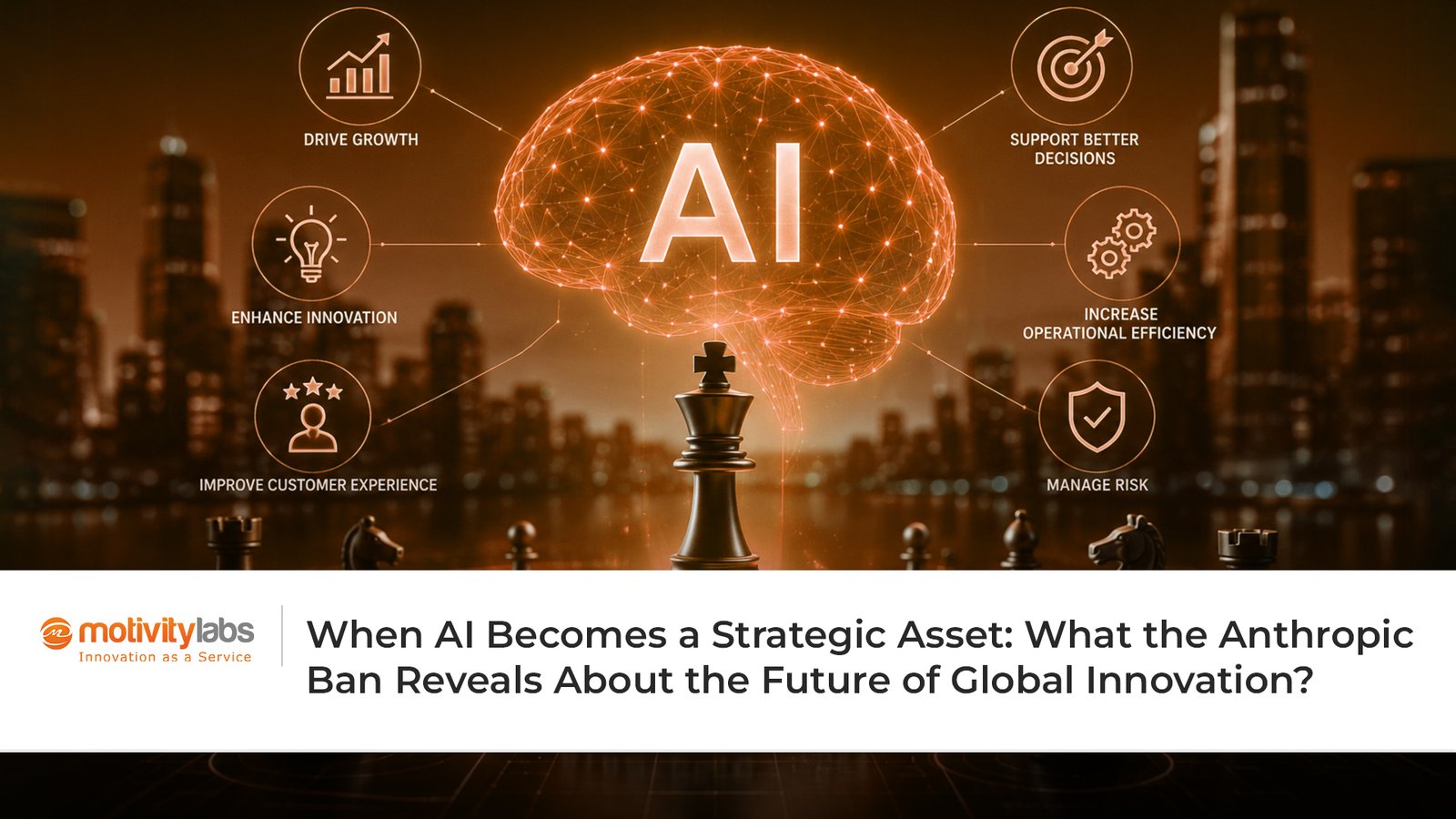
Advanced AI capabilities often create compounding advantages. Organizations with access to better models can accelerate research, automate operations more effectively, improve customer experiences, and develop new products faster than competitors.
If access to frontier AI becomes geographically restricted, countries without access could find themselves at a growing disadvantage.
Emerging economies may be particularly affected. Many regions are still building their AI ecosystems and rely heavily on access to global technology platforms. Restricting access could slow innovation, reduce competitiveness, and limit opportunities for local entrepreneurs and researchers.
At the same time, restrictions may accelerate investment in alternative AI ecosystems. Governments and enterprises that perceive dependence as a risk may increasingly support open-source models, domestic AI initiatives, and regional innovation hubs.
The result could be a more fragmented global AI landscape.
Why the Future May Belong to Model-Agnostic Enterprises
The Anthropic episode highlights an important lesson for technology leaders: flexibility matters.
Organizations that build AI strategies around a single provider risk becoming vulnerable to policy shifts, pricing changes, regulatory actions, or technology disruptions.
Increasingly, enterprises are moving toward model-agnostic architectures that allow them to integrate multiple AI providers while maintaining operational continuity.
This approach enables organizations to adapt quickly as the AI landscape evolves. Rather than depending on one model, businesses can leverage different AI systems based on performance, compliance requirements, cost efficiency, and availability.
The future may not belong to organizations using the most powerful model. It may belong to those capable of switching between models seamlessly.
Motivity Labs' Perspective: Building Resilient AI Strategies
At Motivity Labs, we believe the Anthropic situation highlights the importance of building AI strategies that prioritize resilience alongside innovation.
AI is evolving too rapidly for enterprises to rely exclusively on a single provider, platform, or ecosystem. Organizations must prepare for a future where technological, regulatory, and geopolitical factors influence AI availability.
Our approach focuses on helping enterprises develop flexible AI architectures, scalable data foundations, robust governance frameworks, and model-agnostic environments capable of adapting to change.
Whether organizations are deploying Generative AI, Agentic AI, enterprise automation solutions, or advanced analytics platforms, long-term success will depend on maintaining strategic flexibility.
The companies that thrive in the next decade will not simply adopt AI. They will build ecosystems capable of evolving with it.
Conclusion
The Anthropic restrictions may ultimately represent far more than a dispute between a government and an AI company.
They reveal a deeper transformation taking place within the global technology landscape. Artificial Intelligence is increasingly being viewed not merely as software, but as strategic infrastructure with economic, political, and national security implications.
Whether the restrictions prove temporary or become a model for future AI regulation, one thing is clear: access to advanced intelligence can no longer be taken for granted.
The world is entering an era where AI capability, AI governance, and AI access are becoming intertwined with geopolitics.
For enterprises, governments, and innovators, the challenge is not simply keeping pace with AI advancement. It is ensuring that the benefits of intelligence remain broadly accessible while balancing legitimate security concerns.
The future of AI may depend not only on how intelligent these systems become, but on who gets to use them.