For nearly four years, prompt engineering has been one of the most discussed skills in the Artificial Intelligence ecosystem. From writing better ChatGPT prompts to designing complex instructions for enterprise AI systems, organizations have invested significant time learning how to communicate effectively with Large Language Models (LLMs).
The logic was simple: better prompts produced better outcomes.
However, a new concept is rapidly emerging within the AI community that could fundamentally change how humans interact with intelligent systems. Known as AI Agent Loops or Loop Engineering, this approach shifts the focus away from manually crafting prompts and toward designing autonomous systems that continuously guide, monitor, and improve AI-driven workflows.
Industry leaders from companies such as Anthropic and OpenAI are increasingly suggesting that the future of AI may not belong to those who write the best prompts, but to those who build the most effective loops. If prompt engineering represented the first phase of the Generative AI revolution, loop engineering may become the foundation of the next era: autonomous, agent-driven intelligence.
The Evolution of Human-AI Interaction
Since the launch of ChatGPT in late 2022, prompt engineering has become the primary interface between humans and AI systems.
Users learned that the quality of an AI’s output often depended on how effectively instructions were framed. Detailed prompts, contextual information, structured instructions, and iterative refinements became standard practices across industries.
Organizations developed prompt libraries. Teams hired prompt engineers. Entire training programs emerged around writing effective AI instructions.
Yet prompt engineering still requires continuous human involvement.
Every task begins with a prompt. Every correction requires another prompt. Every workflow depends on users manually guiding the model through a sequence of actions.
As AI systems become more capable, this approach increasingly appears inefficient.
The next logical step is allowing AI systems to manage parts of this process themselves.
What Exactly Are AI Agent Loops?
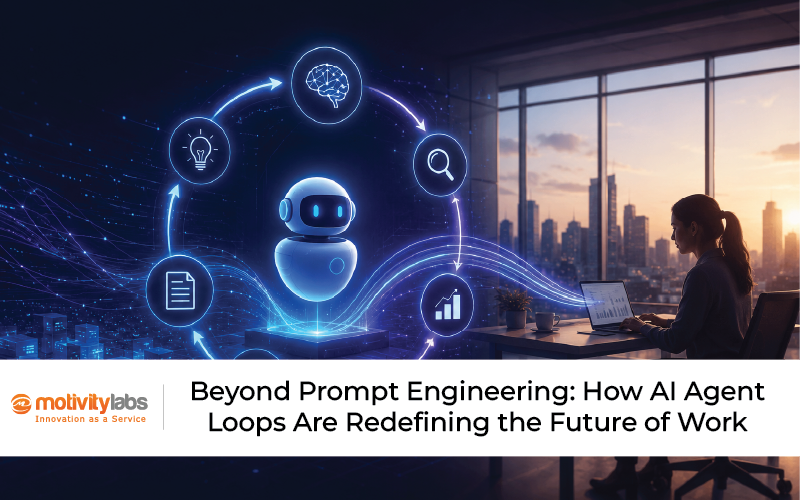
AI agent loops are recurring workflows that allow AI systems to operate with a defined objective while continuously evaluating their progress until a task is completed.
Instead of humans repeatedly issuing instructions, users define a goal, establish rules, and allow AI agents to execute the workflow autonomously.
According to discussions highlighted by AI leaders including Anthropic’s Boris Cherny and OpenAI engineer Peter Steinberger, loops enable one AI system to generate prompts, coordinate actions, review outputs, and guide other AI systems without requiring constant human intervention.
In practical terms, this means users move from asking AI to perform individual tasks toward designing systems that continuously work toward predefined objectives.
Rather than saying: “Write a report.”
The future workflow may become: “Monitor industry developments, collect relevant information, create summaries, validate sources, update the report every morning, and notify stakeholders of major changes.”
The AI system then continues executing that objective through an ongoing loop.
The shift may appear subtle, but it represents a fundamental transformation in how intelligence is deployed.
From Prompt Engineering to Loop Engineering
The emergence of loop engineering reflects a broader transition occurring across the AI landscape.
Prompt engineering focuses on communication. Loop engineering focuses on orchestration.
Instead of optimizing individual interactions, developers design systems that enable AI agents to collaborate, review work, make decisions, and continuously improve outputs.
Industry experts increasingly describe loops as recurring operational frameworks rather than isolated commands. Boris Cherny recently explained that in many cases he no longer writes prompts directly. Instead, AI systems generate and refine prompts internally while coordinating tasks autonomously.
This approach allows organizations to create digital workers capable of handling complex, multi-step processes.
In many ways, loop engineering resembles management rather than programming.
The objective is not to tell AI exactly what to do at every step. The objective is to define goals, constraints, responsibilities, and feedback mechanisms that enable AI systems to function independently.
Why Agent Loops Matter for Enterprises
The significance of AI agent loops extends far beyond software development.
While many early examples focus on coding assistants such as Claude Code or OpenAI Codex, the underlying principles apply to virtually every business function.
Customer support teams could deploy AI agents that continuously monitor support tickets, generate responses, escalate issues, and update knowledge bases.
Marketing teams could create loops that monitor market trends, generate content ideas, draft campaigns, evaluate performance metrics, and optimize messaging.
Financial organizations could deploy agents that continuously track compliance requirements, analyze risk indicators, and generate reports.
Supply chain operations could leverage AI loops to monitor inventory, forecast demand fluctuations, and coordinate procurement activities.
The value comes from persistence. Traditional AI waits for instructions. Agent loops continue working toward objectives.
This distinction transforms AI from a reactive tool into a proactive operational system.
The Building Blocks of an Effective AI Loop
Industry practitioners describe several components that make AI loops effective.
Automation serves as the foundation, enabling workflows to repeat continuously rather than operate as one-time events.
Skills provide specialized instructions that guide agent behavior.
Plugins and connectors allow AI systems to interact with external applications, databases, and enterprise platforms.
Sub-agents divide complex tasks into smaller responsibilities, enabling collaboration between multiple AI systems.
Memory mechanisms ensure that important information persists across interactions rather than being forgotten between sessions.
Together, these elements create intelligent workflows capable of operating at a scale that would be difficult for human teams to achieve manually.
This architecture forms the foundation of what many experts describe as the emerging era of Agentic AI.
The Hidden Challenge: Cost and Complexity
Despite the excitement surrounding AI agent loops, the technology introduces significant challenges.
One of the most frequently cited concerns is cost.
Every action performed by an AI agent consumes computational resources. When multiple agents collaborate, evaluate outputs, perform quality checks, and continuously monitor objectives, token usage can increase dramatically. Industry experts note that complex loops involving multiple sub-agents can rapidly escalate operational expenses.
There are also governance concerns.
Autonomous systems require oversight.
Without proper controls, AI agents can generate inaccurate outputs, create inefficiencies, or make decisions that conflict with business objectives.
Researchers and industry analysts have repeatedly highlighted the risks associated with poorly governed agentic systems, including infinite loops, unintended actions, and operational failures.
As enterprises adopt AI loops, governance frameworks will become just as important as technological capabilities.
Why Human Oversight Still Matters
The rise of AI agent loops does not eliminate the need for human expertise.
Instead, it changes the role humans play within intelligent systems.
Employees increasingly become supervisors, strategists, and decision-makers rather than task executors.
The most successful AI deployments will likely involve collaborative intelligence, where humans establish objectives and AI systems execute workflows.
This model combines human judgment with machine scalability.
Organizations that attempt to remove humans entirely may encounter operational risks. Organizations that effectively combine human oversight with AI autonomy will be better positioned to maximize value while maintaining accountability.
The future is unlikely to be human versus AI.
It is more likely to be human-guided AI operating at unprecedented scale.
What This Means for the Future of Enterprise AI
The rise of AI agent loops signals a broader evolution in enterprise technology.
For years, businesses have focused on automation. Now they are beginning to focus on autonomy. Automation executes predefined actions.
Autonomy pursues objectives. This distinction will shape the next generation of enterprise AI systems.
As AI agents become more sophisticated, organizations will increasingly deploy networks of specialized agents capable of collaborating across functions, systems, and departments.
Prompt engineering will not disappear entirely. It will remain an important capability.
However, its role may gradually become less central as organizations shift toward designing intelligent workflows rather than individual prompts.
The future of AI interaction may involve fewer conversations with AI systems and more orchestration of autonomous digital workforces.
Motivity Labs' Perspective: Building the Foundation for Agentic Enterprises
At Motivity Labs, we view AI agent loops as a natural evolution of enterprise AI adoption.
Organizations are moving beyond experimentation and seeking ways to operationalize intelligence across business functions. This requires more than advanced language models. It requires scalable cloud infrastructure, secure integrations, governance frameworks, data readiness, and intelligent orchestration capabilities.
Building successful AI loops demands a robust technology foundation that can support automation, interoperability, monitoring, and continuous optimization.
Our focus is helping enterprises transition from isolated AI use cases to connected, enterprise-wide AI ecosystems where intelligent agents can operate securely, efficiently, and at scale.
The future belongs not simply to organizations that deploy AI, but to those that successfully orchestrate intelligence across the enterprise.
Conclusion
The emergence of AI agent loops represents one of the most important developments in the evolution of Artificial Intelligence.
For years, the conversation centered around prompt engineering and improving human-AI interactions. Today, the focus is shifting toward creating systems where AI agents interact with each other, coordinate workflows, and pursue objectives autonomously.
This transition from prompting to loop engineering reflects a larger shift from reactive AI to proactive AI.
While challenges around cost, governance, and oversight remain significant, the potential benefits are equally transformative.
As organizations continue their digital transformation journeys, AI agent loops may become the operating framework that powers the next generation of enterprise intelligence.
The question is no longer whether AI can perform tasks. The question is whether AI can continuously manage them. The answer may define the future of work.